Culture
Let's Party Like its 1889!: Etiquette of the Fête in Gilded Age New York (Dressed Classic)
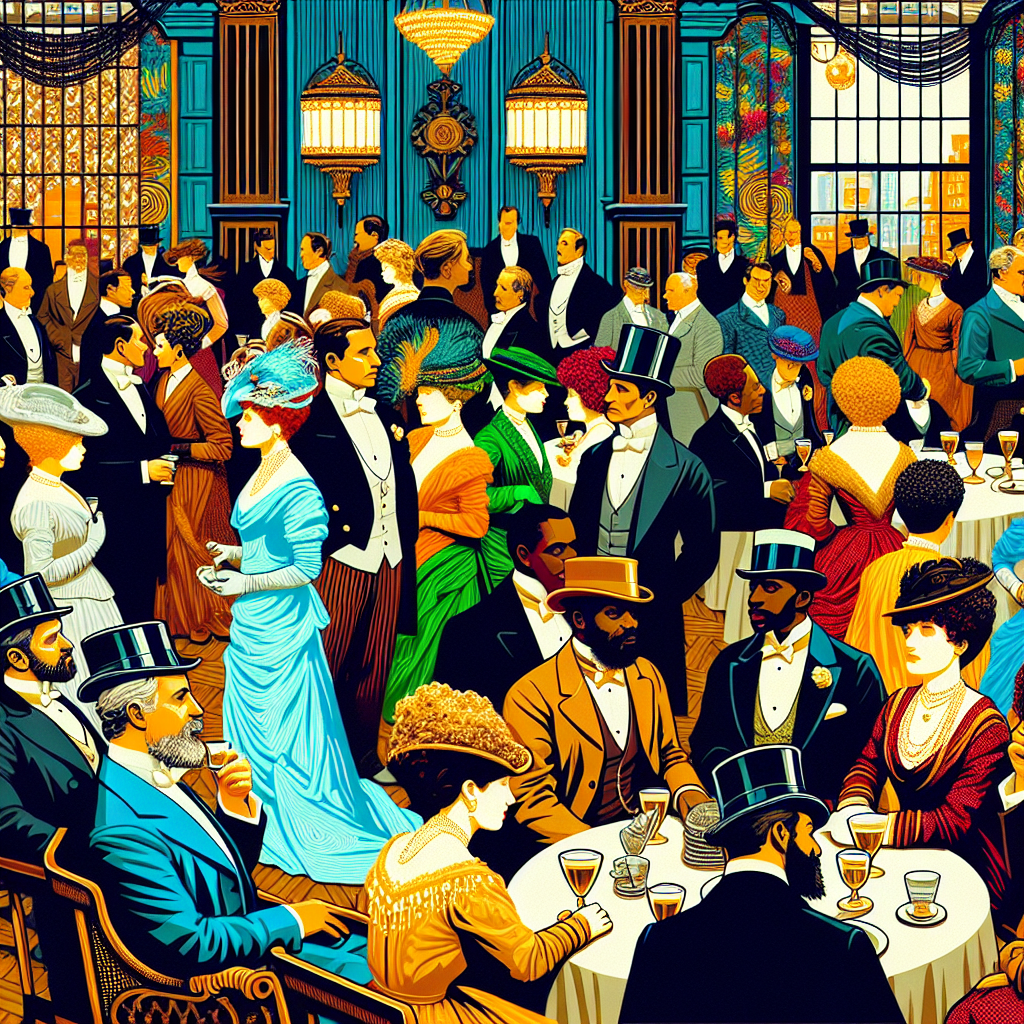
In this episode of Dressed, hosts Cassidy Zachary and April Callahan delve into the intricate etiquette of social gatherings during the Gilded Age in New York City. As they prepare for the upcoming se...
Let's Party Like its 1889!: Etiquette of the Fête in Gilded Age New York (Dressed Classic)
Culture •
0:00 / 0:00
Interactive Transcript
Speaker A
Please enjoy one of our favorite episodes from the Dressed archive of over 500 plus shows.
Speaker B
The history of Fashion is a production of Dressed media. With over 8 billion people in the world, we all have one thing in common. Every day, we all get dressed.
Speaker A
Welcome to Dressed the History of Fashion, a podcast where we explore the who, what, when of why we wear. We are fashion historians and your hosts.
Speaker B
Cassidy Zachary and April Callahan, dress listers. If you are anything like me and Cass, you might just be counting down the days to the launch of season two of one of the most stylish television series to hit our home screens in recent years. And that is, of course, this coming October 29th, which marks the debut of season two of the Gilded Age. And I know for a fact that some of you are out there waiting with bated breath. And I say I know this because it was a topic of much conversation recently when past Dressed guest Raisa Britannia and I were out and about at some fashion events in New York City this past week. Not only our fellow fashion historians, but fellow fashion lovers were kind of like all Twitter about the upcoming release of season two.
Speaker A
And that of course includes us, April. And for many of our listeners who might not have yet had a chance to be captivated by the first season of the HBO series the Gilded Age, it is one of the latest incarnations of the work of writer and creator Julian Fallows, who some of you are probably already familiar with because he is the visionary behind the British historic drama Downton Abbey, which, I mean, I'm obsessed with that show. I still watch it from start to finish every couple years. And that show, of course, followed the lives of their aristocratic Crowley family and their servants on their sprawling Yorkshire countryside estate, and that spans the years from the 1910s to the 1920s. And we have done an interview with the costume designer Anna Robbins, if you're interested in learning more about the costumes of that show, because they're incredible. And like Downton, the Gilded Age is once again giving us that delicious dose of period costumes of nostalg nostalgia. But this time, the setting is New York city during the 1870s, and season two is actually going to take us into the 1880s.
Speaker B
This term, the Gilded Age, of course, refers to an era of massive industrial and economic expansion in American history. It's the period of great social change a few years after the American Civil War, but before the turn of the century. So, roughly speaking, we're talking about the late 1870s up until 1900 or so. And as a historian, I was familiar with the financial prosperity experienced by the American elite during this period. But, Cass, while I was working on this episode, I also learned that this flowering of abundance in the states was actually more widespread than I initially thought. The 1890 census tells us that the annual income for the average American rose nearly 50% between the years of 1880 and 1890. So within a single decade, the majority of working persons, and I'm talking men, women, and children who were working out there at this time, but on average, the working Americans had their income increased by half. So, in theory, this allowed for the betterment of living conditions and also disposable income. But I also just want to issue a caveat here that, of course, this did not apply to everyone in America during the late 19th century, especially recently liberated African Americans or recent immigrants who came to America by the millions in the 19th century. And it was on the back of these people and the exploitation of their labor that many of these industrialists built their wealth. So this was a very sad but true fact.
Speaker A
All of these industrialists, right. However, it goes without saying that for those lucky Americans with newly disposable income, this potentially came with a desire for upward social mobility. And not only do we see a massive expansion of the middle class during this period, many families who had previously been middle class now suddenly found themselves, well, do. And this quote unquote, new money set sometimes had fortune to rival the generational wealth of older, more established American families, right? Who'd been here for centuries, et cetera, who had been wealthy for centuries. And as we learned in season one of the Gilded Age, it would take newcomers more than money to break through the long established social hierarchies to gain entry and acceptance into American high society. We see that tension actually play out in the Gilded Age between the characters of Bertha Russell and Caroline Astor. And Aster was very much a real person and very much a real scion of this period, right? Matriarch of the social scene. Have you. And Bertha in the Gilded Age is a fictional character, but she is no doubt based on the likes of Caroline Astor's new money contemporary. And that would be Alva Vanderbilt and two people we will learn more about in actually next week's episode, which takes us behind the scenes of real Gilded Age fashion and the women who shaped it. But I digress.
Speaker B
I know, but digress away, please. We're not going to go into too. Too much more detail about that today, because we are going to get into it next week. But what I did want to do this week is to give us all a little primer of sorts, about a very important aspect of Gilded Age life that was critical to quote unquote, improving one's social standing in society. And that is, of course, etiquettes. And some of you may remember that we have, of course, already done an episode back in 2020 on the etiquette of the custom of calling. And by calling, I mean the social practice of paying and repaying of visits. So if you haven't listened to that episode already, you might consider tuning back into that first, because today we are going to expand upon that fundamental practice, and now we're going to dance into the realm of party etiquette.
Speaker A
Yeah, And April, I think we were both a little surprised when we got so much enthusiastic feedback from that episode. And that episode, by the way, and I think we've re aired it a couple times, but it was called call me the perils of 19th century etiquette Dress listeners, if you want to check it out. I mean, we got so many messages from listeners asking for more episodes on etiquette practices of the past. I mean, it's incredibly fascinating, I think, because so many of us do not follow these standards today. And so, you know, because we've received so many requests, just made perfect sense to do an etiquette episode in an effort to better contextualize the copious depictions of balls, dinner parties, and various other fetes which will doubtlessly be coming our way in season two of the Gilded Age.
Speaker B
Yes, and I just wanted to thank everyone who sent us those kind messages about the first etiquette episode, because sometimes when I get these ideas for admittedly niche topics like this, I wonder. Huh? Am I the only person that finds this interesting, or is this too nerdy of a topic? Well, apparently not, because you all seem to be here for it, too. So thank you for indulging my nerdy whims. And we will keep doing these deep dives as long as you all are enjoying them. Okay, Cass, so for today's episode, not only will we be discussing party etiquette of the American Gilded Age, because the television show is set in New York City, right? We're actually going to look at the customs of New York City high society in particular. And I was perusing through a bunch of etiquette books from this period to prepare for this episode. And I practically screamed in glee when I discovered the title, Social Etiquette of New York. Ding, ding, ding, ding, ding. This was originally published by d. Appleton & Co. In 1878. Apparently, this title did quite well for itself because a second edition was published in 1886 and yet another in 1891. And it's actually this third edition from 1891 that we're going to be quoting from and using for our purposes today.
Speaker A
Yeah. And listeners, let us tell you these little moments when April and I find a gem of a primary source that is exactly what we need for our research and for writing these episodes. I mean, these are really, really thrilling moments. Yes, I've screamed in delight many times. And it's like, does anyone notice? Does anyone care? Or. You and I usually text each other. But one of our favorite parts of making this show is the research aspect of these episodes. And so finding something like this from the exact time period and the exact city under discussion, April, I'm sure was very satisfying for you.
Speaker B
It was.
Speaker A
And apparently even more important for the sake of accuracy than we may have anticipated, because it's declared in the introduction of Social Etiquette of New York. New York is a law unto itself. So apparently the city had separated ranks from the etiquette codes of London and Paris to create its own unique codes.
Speaker B
Which is fascinating, as we had neither royalty nor rank to decide these matters for us. The time consumed in the adjustment of our social affairs was very naturally extended through many years. We became weary of being asked, how do you do these things in America? When we had no proper reply to make. Indeed, we do have a best society. And most excellent it is too, because we recognize superiority without consulting a doomsday book. And I didn't know what they meant initially by this cast. I had to look it up. And apparently a doomsday book was something that was started in the Middle Ages that listed landowners. So eventually, over the years, this came to be about rank and peerage. So it was about aristocratic titles. The book goes on. We, meaning Americans, know exactly what to do for ourselves and for our visitors.
Speaker A
And the writer continues by pointing out that compared to European codes of etiquette, America places a higher value on, quote, intellectual attainments, mental accomplishments instead of family connections. And while American society seemingly left the door ajar ever so slightly, to quote, unquote, new money, so seeking acceptance into the highest realms of polite society, it was in no means a given. It did not ensure that entry. And newcomers very much had to fight tooth and nail to gain admission to upper class social circles. And one of the skills they were expected to have, without question was a deft knowledge of social customs. And of course, this is something we see play out throughout the entire first season of Gilded Age.
Speaker B
Yes, quote, etiquette is the machinery of society. To enter a social circle without being familiar with its customs and its best usages is like attempting to dance a quadrille without knowing its forms. And for anyone unfamiliar with this term, quadrille, it refers to a very specific style of dance which was performed at balls and parties wherein four couples were arranged in a rectangular formation and executed choreographed dance steps. And I'm sure that all of you have seen this depicted on screen and countless times in various productions. So the participants in a quadriole of this form of dance would of course be expected to know the dance steps in advance if they wish to partake in that evening's revelries, where dancing was one of the main forms of entertainment. And this brings us to our very first topic of investigation, which is going to be balls, parties and Germans. And no, I do not mean individuals from the country of Germany, but rather a type of entertainment which incorporated both dancing and games. But more on that in a moment.
Speaker A
Yes, because first we need to establish a framework for the basic party etiquette which is detailed in the chapter of Social Etiquette of New York entitled Giving and Attending Parties, Balls and Germans. Again, not the country. It's so funny.
Speaker B
I know, it just feels weird to say it, right? It's not a term that we are accustomed to.
Speaker A
Attending parties, balls in Germans. Those Germans need a lot of attending to anyways. Trust listeners, Trust us when we say that the amount of expectations put upon not only party givers, but also party goers during the 19th century would be incredibly anxiety inducing to us today. The rules are numerous and extreme vigilance to one's interactions and a heightened awareness of one's surroundings was necessary at all times. God forbid you make us faux pas. And all of this began before the party even started.
Speaker B
Yes, that's right, Cass. Because just planning the party had its own set of practices to be followed. Prior to issuing invitations to balls or dinner parties, the hostess to be was expected to pay a call or a visit upon each of her potential invitees. And it was only after that call had been paid that she could then send the invitation to her upcoming social event. And when I say invitation, I really mean an invitation here, because in high society this almost always meant a custom engraved paper invitation along with a response envelope which were to be hand delivered by the host or hostess's servants or.
Speaker A
Through the mail, which is an art form that we are losing. Right, because so much is digital now. So keep sending out paper invitations people, because. And an interesting fact here is that balls and parties were considered to be separate social occasions and therefore had slight differences in their etiquette. So invitations for balls were to be sent out 10 to 20 days in advance, whereas party invitations were to be sent 10 to 15 days in advance. A slight difference perhaps, but when to send invitations was not the only variance between the two. Even the invitations themselves were were to be written in a different manner. So for a ball, the printed invitation would list only the hostess's married name as the party giver, whereas for a party, both the hostess and her husband's name would be listed. So an example of a proper ball invitation is given here and it says, Mrs. Farquhar Alexander, request, request the pleasure of your company on Tuesday evening, October 5th at 10 o'. Clock. And then under that on the left it says dancing. And to the right of that 28.
Speaker B
Silver Place, any of you out there are like 10 o', clock, 10pm I go to bed at 10pm Yeah, I know, me too. Join the club, because I do go.
Speaker A
To bed like nine.
Speaker B
But during the 19th century, socializing across all age ranges went later into the night compared to now, I would say. So our little tome of etiquette tells us that the priority proper time to start a party in New York is between the hours of 9 and 9.30pm whereas a ball could start later anywhere between 9:30 and 11pm we are also instructed as to the proper time of departure for guests, which is very interesting. For a party, this should be no later than 1am A ball, however, was an entirely different matter. So this would commonly go on until 3am if not dawn. And in fact, in season one of the Gilded Age, we do see some of the ball goers exiting missiles Russell's Ball in full daylight. They had literally danced the night away.
Speaker A
And I know we're going to talk more about this ball in a minute here, but there is so much historical, not actually accuracy, but that ball and so much featured in the Gilded Age is based on so many, like actual people and actual event, including this ball.
Speaker B
And there's a ton of press coverage. If you go back to the 19th century newspapers and the New York Times, tons and tons of press coverage of these balls, including describing the flowers and the food and yeah, it's out there.
Speaker A
And of course, for our intensive purposes, the costumes, the pictures of the ball were printed. I mean it's. So there's, it's a wealth of information. It's so fascinating. And no wonder Julian Fellowes was inspired by this era to create this story. So the run of show for a party and A ball was also a matter of timing. So dancing was a favorite activity at both, but not necessarily required for a party. And if there was to be dancing at a party, how to convey this information was a matter of, you guessed it, etiquette.
Speaker B
Okay, I just have to interject here a little bit and say this is one of the more finicky practices of party etiquette that I discovered. And the fact that this etiquette extended how invitations were printed and sent is completely wild to me. But Cass, tell us all about this. Tell us more about this.
Speaker A
Bear with me. As I mentioned earlier, an invitation to a ball would have the word dancing engraved at the lower left hand corner of the invitation. However, for a party, this was apparently optional, so you still had to tell some of the invitees that there would be dancing. But depending on who the guest was, maybe you didn't tell them that there was dancing. So the book explains this quote. Another style of card or note does not have dancing engraved upon it because some of those who may be invited are too mature to enjoy this activity or, or are in mourning and will be disturbed at the suggestion, even though they would feel hurt if omitted from the list of those who are bidden not to hurt these sensitive persons. Another card, small in size, with dancing engraved upon it, accompanies some invitations, but is omitted from others.
Speaker B
This is already starting to get confusing and I see a lot of potential for messing things up. But there is also a third option, and I would argue that this, this third option makes a lot more sense, streamlines this whole situation. Another way to do this would be more akin to that original style of invitation that Cass mentioned, where the word dancing was at the bottom left. But it would specify the time at which the dancing was to begin. So for instance, it would say dancing at 11pm so what this does is it extends a little caveat, I guess, if you will, to the partygoers who would like to attend but might not wish to stay for the dancing portion of the evening. This seems way more sensible than to remember whom and whom not to send that extra dancing card in the envelope. This. This would stress me out. And it's not even the day of the party yet.
Speaker A
Yeah, well, imagine how stressed out people on the other end might be as well, waiting for an invitation to a particularly hot party or ball. And being invited or not invited really spoke to your social standing at this time and really how well you were like as well, right? And emotions really ran high around this topic. For those invited to the soirees, a reply to the invitation was expected within two or three days so the hostess could move forward with preparations.
Speaker B
I want to come back to this matter of how an evening played out for a bit, because both refreshments and supper was expected to be served at both parties and balls. But when and how was again matter of some difference. At a party, dancing seldom begins until after supper, as the cards will suggest. Conversation, music, etc. Occupy the earlier part of the evening. But in the case of a ball, the order of its dances is engraved upon a pretty program. Some ladies send out this program with their invitations, but this is by no means as universal as it should be. Waltzing interspersed with square dances, AKA quadrilles, like we defined earlier, occupy the time until supper is announced or the door of the supper room is thrown open.
Speaker A
Which apparently was a whole big deal. So it was really the pinnacle of the evening. So for an elaborate ball quote, the supper room is arranged with choice articles of food, both cold and hot, and is usually opened at half past twelve or one o'.
Speaker B
Clock.
Speaker A
But light refreshments such as ices and cakes, also sandwiches and such drinks as to satisfy very taste and including coffee, chocolate, lemonade, bouillon and most likely punches and wine, are accessible to guests during the entire ball and are set out upon side tables, buffets, et cetera. So that's the end of the quote. And it seems that hosting a party of this magnitude was not only elaborate, but also an incredibly expensive display of one's wealth. And of course that plays out in dress. Yes, yes.
Speaker B
And at balls. Of course, it goes without saying that the balls you were to wear your most formal of dress, whereas parties could be slightly less formal on that matter of expense cast. Some of these lavish balls were jaw droppingly expensive. And one of the most famous in history was Alva Vanderbilt's now legendary costume ball of 1883. And this ball cost an estimated six to seven million dollars today. Wow. Apparently $2 million of that was spent on champagne and $350,000 was spent on flowers alone. So again, one of those balls that is widely described in the press of the era, and you know, we're talking about opulence here on the extreme, if not condemnable excess.
Speaker A
Yeah. And especially because of the wealth gap between the lower and upper classes at this period you had all of these impoverished people in the United States and then these incred wealthy people just living, living it up beyond anything you could possibly imagine.
Speaker B
And let's just also not forget this is prior to federal income tax. So that is, that is part of the part of the reason why these.
Speaker A
Massive fortunes were and I'm glad you actually mentioned Alva Vanderbilt's bell because obviously we couldn't do this episode without mentioning it. But Julian Fellows has actually admitted to using her ball as the basis and inspiration of for the grand ball that is thrown by Bertha Russell in season one of the Gilded Age. And we have also done an entire episode on this ball in which guests came in this incredibly fascinating, fantastical myriad of costumes. And if you want to learn more, we will link to it and the other episodes we've mentioned in our show notes because I mean it deserved its own episode and so we gave it one Dress listeners, we are going to take a short sponsor break here. More on Party Etiquette when we come back. Back.
Speaker B
Obsessed with your favorite luxury brands, but on a RealReal budget well, join Cass and I over at the RealReal where we have been customers for years.
Speaker A
Yes, well over a decade at this point.
Speaker B
Me too.
Speaker A
And dress listeners, you can both shop and sell at the RealReal, which is great because you can use your earnings for something special and new to you. The RealReal is all about giving clothing and accessories second chances, which is great for the planet and your wardrobe. The RealReal has found new homes for over 37 million authenticated luxury items so they know firsthand the impact resale has on the planet. Rather than producing more stuff, the RealReal is making what already exists new to you.
Speaker B
The RealReal is the easiest and fastest way to sell with more than 40 million members ready to shop in your closet. They use real time data to determine the highest possible price for every item and they handle all the work for you, from photography and copywriting to shipping and customer service. Because your to do list is already long enough.
Speaker A
The Real World is the world's largest and most trusted resource for authenticated luxury resell. With thousands of new arrivals daily. No one does resell like the RealReal and this month you can get an extra $100 site credit when you sell for the first time. Just head to therealreal.comdress to get your extra $100. Therealreal.com dressed that's therealreal.com dressed.
Speaker B
Welcome back. We have just been talking about the cost of some of these parties and digress a little bit from our formal topic of etiquette. And I would like to talk about one of the most interesting aspects of party etiquette that I learned while working on this episode which goes back to this point in the party where supper is served. Quote it is customary for a lady, and then by extension her chaperone, to visit the supper room with a gentleman with whom she has just been dancing. And I want to talk about this because what this really does is it opens up a bigger discussion about the etiquette of escorts, chaperones, and gender roles.
Speaker A
And there is perhaps no better example of how highly codified interactions were between the sexes during the 19th century, the late 19th century, than a ball. And I'm sure many of our listeners have heard this term dance card, because today, I mean, we use this term rather casually, right? We say we use it in the context of like to mean one schedule or agenda. My dance card's full. Sorry, I'm not available. But dance cards were actually a real thing, an actual object. And you see these, for instance, in Bridgerton, they have their actual dance cards. And so the program in order of dances was listed for partygoers. And gentlemen would ask ladies for the favor of the a specific dance. And if the woman was unmarried, she would be expected to be in the company of a married friend or an older relative to function as her chaperone. You never would have gone unchaperoned. Men were advised when asking a lady to dance to, quote, recognize the office and authority of the chaperone, end quote. And when their dance ended, the gentleman was expected to, quote, return the young lady directly to the care of her married or her older lady friend as soon as the dance is finished. He may linger there to converse with her, but not elsewhere.
Speaker B
And Cass, you know this already, but our listeners won't. But this week I was hanging out with our friend Rebecca Devaney from Paris. She was visiting New York all week. And Rebecca runs textile tours of Paris. We cannot say enough lovely thing about her or her tours. So if you are in Paris soon, be sure to look her up in advance. If you would like, like to take one of her tours. They regularly book up, but one of her tours is of Les Pousses, which is, of course, the historic flea market that we also visit when we do our fashion history tours of Paris. But she was telling me a few days ago that one of the shops that she takes her visitors to regularly has examples of ivory dance cards. And I want to describe these to you because, you know, it's kind of like, hard to imagine exactly what this looks like. It's not exactly a notebook. They usually take form of what I can best describe as a teeny, tiny rectangular fan. So there's a pivot point that holds the decorative cover together with these little ivory slates that fan out. Right. And you could write down on the ivory fans the name of the dance and your promised date dance partner.
Speaker A
Yeah. And there's actually a really great example of one of these in the collection of the Museum of Fine Arts, Boston. And it measures just under 2 inches by 1.5 inches, or 5 cm by 3.5 cm, has an engraved mother of pearl cover and five ivory slates behind it. Although this example is missing them. These types of dance cards were commonly on a chain and they had tiny little pencil that could be removed, but that were attached to them. And what is so remarkable about this example at the MFA Boston is that it still has its writing on it, which.
Speaker B
I know, it's amazing. How has it survived this long with all the writing on it?
Speaker A
And the owner of the dance card had apparently promised the quadrille to Mr. Armory and not one, but two dances to Simply Loring. And all of the other dances had Mr. Written in front of them, but not Loring. So she must have been on more intimate terms with him, perhaps, Especially since she promised him the German and more on this mysterious German to come. We promise.
Speaker B
Yes, yes, yes, yes. It's coming soon. But the thing that I wanted to point out that Rebecca was telling me is that the proprietor of this shop that had examples of these at Le Pouce was telling everyone in her group that because women wrote on their dance cards in pencil or graphite, it was easily erasable, Right? So they could be used again and again and again. But sometimes women would, quote, unquote, accidentally erase the name of someone she had promised a dance to in favor of a partner that she liked better. And then she could just simply feign innocence and show her dance card, you know, with the second gentleman's name on it. When her first suitor came to retrieve her for their spin about the dance floor, she could just be like, oh, no. So sorry, I think you must be mistaken. This dance is promised to Mr. X.
Speaker A
My bad. Yeah, well, it's not very nice, perhaps, but this was probably a not infrequent occurrence.
Speaker B
I'm sure it happened a lot, especially.
Speaker A
For the dance, which was to be performed immediately before supper was to be served. And this is because, quote, it is customary for both ladies, and this is the young woman and her chaperone to visit the supper room with the gentleman with whom the young lady had has last been dancing. No observable disinclination to accept this escort is possible on her part, no matter what previous anticipations she may have indulged.
Speaker B
As Their escort, the gentleman's role is to attend to any and all of the lady's needs at supper and to, quote, be careful to see that the lady is properly supplied and is made as comfortable as possible before he refreshes himself. And also likewise, if a gent accompanies a lady or a party of ladies to the ball, but it's not her separate escort, he must be certain that they are properly attended at this important moment before he can offer his services to others. This sort of courtesy is lovely, and I'm sure it was well appreciated at the time. But all of this finickiness, Cass, has me a little exhausted, and I just want to go home and watch Netflix. So there's just so many opportunities to make mistakes or cause hurt feelings with a slight if you meant to, or even if you didn't mean to. There has to have been a ton of social intrigue and gossip that happened the next few days after some of these events.
Speaker A
But in terms of spending supper time with your gentleman escort, there was one loophole that women had at their disposal, and that was to entirely forego the dance immediately before supper was to be served. Among the few liberties which a young lady enjoys at a public entertainment is the privilege of refusing to dance with such applicants for this honor as she chooses to disregard. If she refuses an invitation to dance at a private ball, as has just been mentioned, she loses the dance altogether.
Speaker B
I love this so much. Basically, if she decides to sit at the dance, then she doesn't have to sit with anyone in particular at supper. And I'm just imagining, like, all the scenarios where this is invoked in order to sit with that someone that you did want to spend time with at supper. Perhaps your parents didn't want you to spend time with. I don't know. I'm just saying that there's probably, like, a lot of drama playing out around this move.
Speaker A
Yeah. And it also just kind of makes me sad or contemplative about the fact that they said this is like, one of the few liberties she enjoys because custom dictated so much of how a young woman had to act, be who she married, et cetera. So it's nice to see at least she has sub liberties. Okay, dress listeners, you've been waiting patiently for more information about this German situation. Keep mentioning. And April, and I have to admit this was not something that either of us were familiar with. I certainly wasn't. I know you weren't either, April. We both had to look it up. The etiquette manuals at this time sometimes take for granted that everyone contemporary to that time was familiar with what they refer to. But now, more than 100 years later, some of these specific terms have of course lost their full meaning to us today. And such is the case for us, at least with the word German.
Speaker B
And here is what we found out when we looked into it. The German is another group dance and a very specific form of the quadrille, which started out being called the German quadrille before it was just shortened to the German. It is a combination of sorts of dancing and party games, such as musical chairs. And apparently this is where musical chairs got its start.
Speaker A
Interesting.
Speaker B
And all the participants vied for prizes. The German was to be performed immediately following supper as a form of after dinner entertainment when guests were suitably fed and perhaps had indulged in a bit of libation, AKA maybe people are a little tipsy at this point. So the German is often comical because of the these silly party games that were incorporated into it. Sometimes it's written about that these situations could potentially be embarrassing. But the whole point of the German was to provide amusement for the fellow guests. And all of the participants in the German knew what they were getting into in advance. So groups of friends interested in creating their own German formed a coterie to practice their performance of the German in advance of specific balls.
Speaker A
Quote the leader of the dance is to be selected with discretion by the hostess. And the favors prizes, which are always provided for the dancers, are chosen with individual and refined taste, always avoiding ostentatious display. End quote. We learned that. Quote, if a coterie meets for practicing the German, it is customary for each lady member of it to invite the club to her own home during the season and also other guests, as agreed upon by bylaws from her own particular friends.
Speaker B
Yeah, so this is a whole thing. You and your closest friends would form your own German club, but other friends who didn't want to perform the dance could just hang out with you as guests. And there were lots of rules and apparently bylaws, which I found a little bit surprising. And as always with this period, there were definitely engraved invitations. So for any of you who watched season one of the Gilded Age, there was a little bit of drama around teenage daughter Gladys Russell and her friends practicing a group dance for the upcoming Russell Ball. And at one point, Mrs. Russell tells her daughter Gladys that one of the participants, Carrie Astor, was no longer allowed to perform as her mother, Mrs. Astor, had refused Mrs. Russell's in person visit. It. This was a massive social slight. We don't need to get into that. But what I'm pointing out here is that this group dance depicted in season one was just this. That was their little. When they're practicing, that was their German coterie.
Speaker A
But it might be that a little bit of this drama around Carrie Aster participating in a ball hosted by a new money family is that as a member of the German coterie, Carrie would be expected to host one of the practice sessions. And the engraved invitations to German practice sessions were to be issued in the name of the young unmarried woman's mother. So Mrs. Astor would have been welcoming in the German coterie of a new money family into her own home. And this was a social acknowledgment of a sort of her acceptance of the Russells in New York high society over which she reigned. So, again, based on true events, which is just so fascinating.
Speaker B
Also, another interesting fact is that if a hostess of a ball invited a German coterie to perform at her event, it was the hostess who was supposed to provide the engraved invitations for the practice sessions. So an invitation to something like this might read, Mrs. Request the leisure of your company at a meeting of the German coterie Tuesday evening at half past eight. The young woman who is the member of the German club who was hosting that specific practice session, it would be her mother's name that was. Would fill in that first blank. And just another kind of quick, fun fact, at these practice sessions, it was considered entirely appropriate that the dance teacher or the dance master also functioned as the sanctioned chaperone, as most of these German clubs were of the younger set, and that meant many of them were not yet married.
Speaker A
So, listeners, remember when earlier I mentioned that these German coteries were allowed to invite guests to their practice sessions. So these guests, while technically not a member of the club, had their own etiquette rules to follow. Quote, calls or visits to return thanks, offer congratulations, and for inquiries are made on the first receiving day of the hostess by each guest who is not a member of the club, whether her invitation was accepted or declined. So the members of the coterie are not expected to heed this formality. Who can keep this straight?
Speaker B
I know. Here we go again. This is so much. So basically, if you invite your friend to come watch your dance practice, then they are expected, whether they come to the practice or not, to come visit you in person the next week to say thank you for that invitation. But the people who actually practice the dance are not expected to pay you a formal visit. I don't know, listeners, I'm asking you guys, do you think that you all can manage this level of formality.
Speaker A
Not at 17, 16, however old they are. Nope. No way.
Speaker B
Oh my gosh, Cass. We have so much etiquette territory that we have covered and we have yet to even begin to discuss dinner parties.
Speaker A
No one here will be surprised that etiquette manuals of this era have a ton to say on the subject of table manners. We will not detail that today. We are going to focus instead on the general behavior and expected at dinner parties. In fact, one's ability to negotiate the numerous potential pitfalls would be much more noticeable at a more intimate social occasion like a dinner party.
Speaker B
As Social Etiquette of New York tells us, quote, we need not search beyond the conventionalities of the banquet to inform ourselves of the subtlest perfections of refined taste or semi barbarism. So, beginning with the invites once again, and if we return back to our episode on calling or visiting etiquette, we will recall that women had set, quote unquote, at home days or a set day of the week when she remained at home to receive visitors. So your at home day might be a Thursday and it would say so on your calling card it would say at home Thursdays. And this is how people knew when to pencil you in to pay or repay social obligations with a visit. And I did not know this until working on this episode, however, that apparently women also tended to have set days when they hosted dinner parties. So you could actually have set invitations printed right, because these are all engraved. So your set invitation for a dinner party might read, Mr. And Mrs. James Knox Wren request the pleasure of Blank Company at dinner on Monday evening, Blank at 7 o'. Clock. And down at the bottom is your address, 11 Clinton Square. So with those blanks, all you had to do is to write in the name of the guest and the date and you're good to go because your dinners are always on Mondays. And one little thing that I want to point out here on this invitation or any of these invitations that we have mentioned so far, that nowhere on this does it say RSVP.
Speaker A
And that is because apparently by the 1890s or so it was kind of considered tacky, quote. Of course, RSVP is still seen upon many invitations, but it is falling into disuse and will soon disappear. It is equivalent to mentioning to your hoped for guest that you are not quite sure if he knows enough about the customs of good society to reply to an invitation to dinner.
Speaker B
Too bad we still, more than 100 years later, have not learned this lesson in New York City. Let's just say that maybe etiquette in New York is a little lax right now. There's also this entire culture of canceling at the last minute. A friend of mine moved to New.
Speaker A
York's culture for that.
Speaker B
Yeah, yeah, a friend of mine moved to New York last year and she was shocked when she got here about this canceling culture. Who does that? And it's such a whole thing that there are a ton of memes out there about it. And I guess people could argue this is because we are quote unquote so busy now. But canceling last minute would have been practically unthinkable in the 19th century, and especially bad form. And what good form was they say replies should be sent immediately so that if regrets are made, vacancies may be filled. A delay and is unpardonable. So a delay in response is unpardonable. And the book also goes on to tell us that there are truly only 3, quote unquote valid reasons for turning down a social invitation. And it should be listed when you decline the invitation. You can claim a previous engagement, you can claim an illness, or simply sorrow. I find this so funny. And of course I know sometimes they mean mourning, but now it's just so funny just to be like, I'm so sorry I cannot attend your party. Sorrow, sorrow, I'm gonna steal it.
Speaker A
Well, if not replying promptly to an invitation was unpardonable, then coming late was completely disastrous. As we are told that quote 5 or 10 minutes is the customary interval between arriving and the dinner hour. And this is FASC when you realize that they're coming by horse drawn carriage. So if the invitation says 7:00pm, going into dinner would begin at 7:05 or 7:10. And we say going into dinner because this is in and of itself, it has its own animal of etiquette. Of course it does. So arriving for a formal dinner party, one would be greeted at the front door by a servant and pointed in the direction of a gendered, quote unquote dressing room. Men would go to the left, women to the right, etc. There one could store any outerwear or accessories no longer needed. And this, this also happened for parties and balls. But for a dinner party there was an extra step for gents. So on their way to their dressing room, male guests would drop a calling card into a tray permanently used for this purpose. And more on why in a second.
Speaker B
Ladies entering their dressing room could expect to find there a diagram of the table accurately drawn with the name of each lady and gentleman written in its place. And Servants in attendance. Attendants could call attention to this diagram if a guest is likely to forget to study it. This diagram explains whom each guest is to have as a partner at the table and upon which side of the host. Each pair is to look for places which were again indicated on the table by location cards.
Speaker A
This reminds me of Pretty Woman, that scene in Pretty Woman where she, like, doesn't know what fork to use and like, like, it's just a fork. Imagine going into a dinner when the entire thing, from start to finish, you have to know how to act every single minute of the day. Yeah, it's fascinating and just also incredibly overwhelming. So, speaking of cards, those calling cards with their own names on them that gentlemen were to drop on the tray and the entryway on their way in that we were just talking about. Well, upon exiting their dressing room, they were to retrieve their card from the servant who would have written it on the name of the woman he was to escort and sit next to for dinner. In the case that the gentleman, if unacquainted with the ladies assigned to them, reminded the host or hostess of this fact and their presentation is speedily made.
Speaker B
Apparently, this all moved rather quickly because immediately he would walk up and offer his left arm to the lady for whom this honor has already been determined upon and leads the way to the dining room. He places her at his right hand. Other gentlemen and ladies follow, the hostess being the last, and she asks the selected gentleman if he will take her into dinner. The offering of the left arm on this occasion had its origin in feudal times when the right hand was kept free for handling a sword which was always worn at first feasts. And this is likely to continue in good form as long as ladies wear trains which they must protect and which gentlemen do not like to tread upon.
Speaker A
So seating arrangements were very strategic, as you can see, and generally speaking, alternated man, woman, man, woman for the purposes of conversation, but also were dictated by the presence of honored guests. So if an honored guest is present, this quote, quote settles beyond question. Who is to go into dinner with the host or hostess? The lady is escorted by the host to the table and placed at his right hand. But if the honored guest be a gentleman or the husband of the honored lady guest, he goes into dinner with the hostess and sits upon her right.
Speaker B
Hand quote, if there is no person to whom an especial attention is to be shown, the eldest lady, the wife of the highest official, or the most eminent scholar, or the one who is the greatest stranger, is offered the arm of the host. Oh, my Gosh, so many more pitfalls here. What are we gonna do, Cass? What if we have strangers, scholars, officials and elderly women, all as guests? Who gets picked? What are you gonna do?
Speaker A
Well, one thing is certain, and that is that both men and women were not to remove their gloves until after they were seated at the table. Guests were, however, not expected to put them on for the rest of the evening indoors unless dancing took place. Another no no was apparently to appear out of sorts in any way. Quote, it is proof of fine breeding to seem to be happy whether one is content or not. Moods should be your own secrets.
Speaker B
I guess that means talking about your feelings at the dinner table is completely out of the picture. There's another weird little gem, and I use that term sarcastically here for from this title that deals with the matter of dinner conversation. Quote, dinners above all social occasions in New York are the most agreeable opportunities for fine conversations and a display of brilliant wit. The woman who talks well is forgiven her brightness if she will use it to enliven a feast. So what are they saying there? She is forgiven for being smart and bright.
Speaker A
Not something that was prized much, I would say, in these times. I don't know. Although, as we know about so many of these women, they're incredibly bright. Right?
Speaker B
And ambitious.
Speaker A
Yes. And fighting. Especially Alva Vanderbilt. So the divide between the sexes is solidified even further after dinner when, quote, the hostess bows to the lady at the right of the host rises and all rise. Also, the gentleman who took the hostess to dinner goes with her to the door and stands there until all the ladies have passed out. When he returns to the table, table, the host changes his seat and places himself to the left of the special guests, and the others group about them. The wines and liqueurs, also cigars, if there is no smoking room, are placed by the host and the servants leave the room.
Speaker B
And the volume goes on to say, quote, some ladies object to this separation of guests, but there really are reasons for it. It permits an easy regrouping of guests where each may find an opportunity for. For talking with a chosen friend, their pairings at table having not been of their own seeking. End quote.
Speaker A
And this reminds me of our mention of the fashion history books last week, the Patchwork. Remember we talked about the men and women being separated and how women would sometimes make the cigar quilts during this period of separation while the men were smoking cigars. So super interesting.
Speaker B
Yep. Yes. So eventually, the gentlemen would rejoin the ladies in the drawing room. At that point in the evening, coffee and tea was to be served, as well as, quote, a small carafe of brandy. Also wafers, tiny sandwiches with anchovy or pate de foie gras in them. This seems like a lot of food, right? These are snacks being served after dinner. Dinner was already had at the table, but at this point in the evening, quote, it is not expected that anyone will remain after 11 o' clock o'. Clock.
Speaker A
I mean, this part is genius. I will take this one because it's a set time when guests were expected to, you know, thank their host and.
Speaker B
Say their farewells promptly at 11pm as.
Speaker A
We are also going to do today. Dress listeners, the time has come to wrap it up and we hope that you have enjoyed our little jaunt into a bit of party etiquette of the Gilded Age. Although April, it made me realize too that we probably are, well, long overdue for an episode that describes the actual, actual fashions that were worn and expected to be worn by these women and the etiquette of fashion, right? What you wore to a dinner would have been incredibly different than what you wore into a party or a ball. So perhaps that will be another deep dive in our near future that we've been talking about for years. And we hope that this gave you an insight or two into the on screen workings of film and television series set during this period. And stay tuned next week as we will do delve further into the fashions of this time. And until then, may you mind your P's and Q's next time you get dressed.
Speaker B
Remember, we do love hearing from you, so if you would like to write to us, you can do so by emailing us@helloressedhistory.com you can also DM us on Instagram restorepodcast, which is where we post images supporting each week's episodes. If you would like to check out the Instagram content specifically associated with this episode, you can search the hashtag dressed326. That's dressed326. Thank you as always for tuning in and more dressed coming your way on Thursday. The History of Fashion is a production of dress media.