Culture
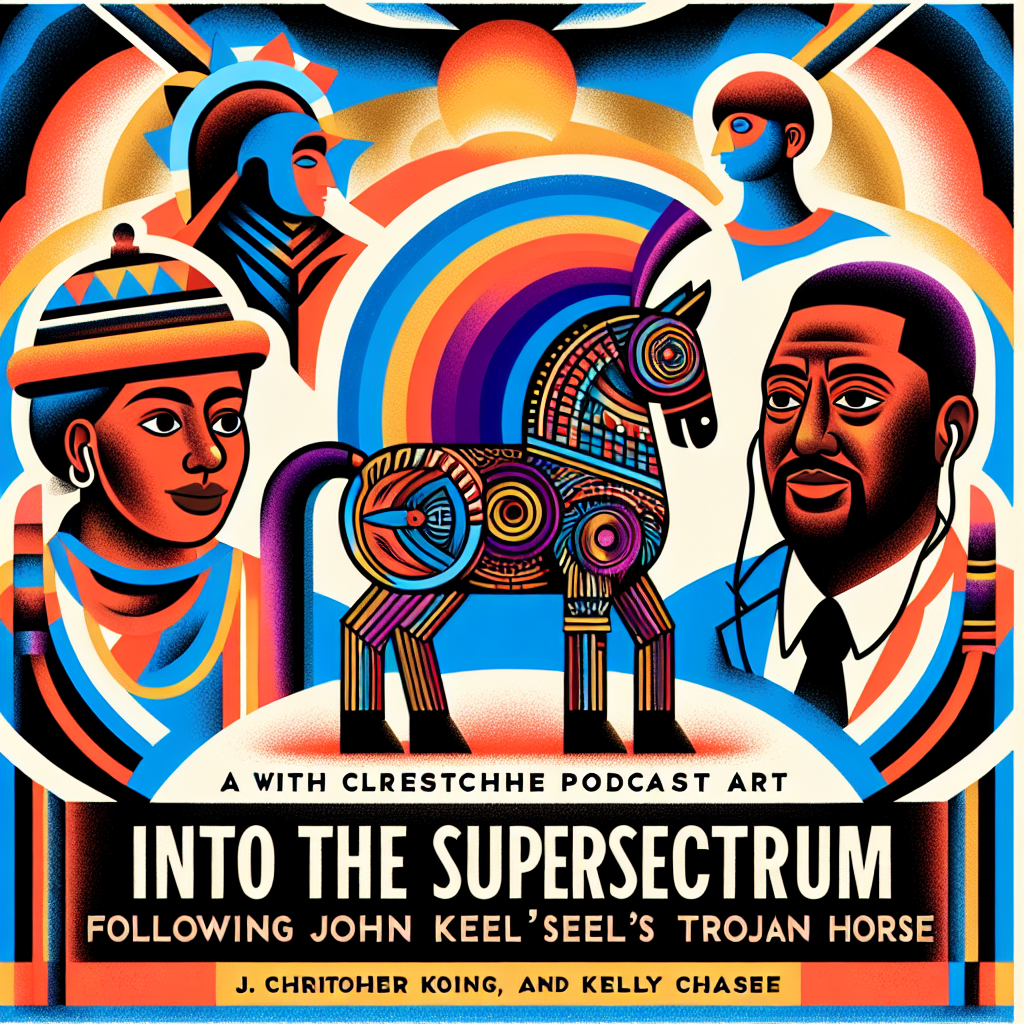
Into the Superspectrum: Following John Keel's Trojan Horse
In this episode of Cosmosis, hosts J. Christopher King and Kelly Chase explore John Keel's groundbreaking work, 'Operation Trojan Horse,' delving into his paraphysical hypothesis and it...
Into the Superspectrum: Following John Keel's Trojan Horse
Culture •
0:00 / 0:00
Interactive Transcript
Speaker A
Hey, friends, it's Daniel Noah here. I'm the director of Spectrovision Radio. So many of the ideas that permeate the genre stories we tell are actually based on real paranormal phenomena. The way we've represented these powerful experiences really only begin to scratch the surface, not just of the way they work, but of the way they feel. When the fine folks at oneypress approached Spectrovision about creating a comic book series based on real paranormal phenomena, we jumped at the chance. High Strangeness is a series of five interconnected stories created by actual experiencers committed to portraying the reality of paranormal experience as it truly is. Strange, disorienting, beguiling, frightening and awe inspiring. It's got UFOs, cryptids, men in black, and I mean the real men in black, not the other men in black. Synchronicities, interdimensional portals, a deep underground military base, and so much more. This October, oneypress and Spectre Vision are proud to present PI Strangeness, a five part experiment in comic book storytelling boasting an otherworldly cast of comic book talents like Christopher Cantwell, Christian Ward and jock Chris Condon. Ringo award winning artist Dave Chisholm, Cecil Castellucci, Timothy Renner of Strange Familiars, our own Jim Perry of Euphamet. Look for High Strangeness, book one, on shelves Oct. 8 at a local comic book shop near you. But be warned, when you look into the abyss, the abyss looks back.
Speaker B
Spectre Vision Radio.
Speaker C
They both see the connection between kind of ancient, you know, fairy lore and other types of folklore and those kinds of sightings and the things that are happening today. So they're both talking about something that seems to be more here than somewhere else, and also that seems to have some vested interest in controlling number one, how it's perceived by us, and also perhaps seeding some kind of mythology or information or belief into the culture through these kinds of sightings and encounters with people. I think that's really cool. What I love about Kiel is that valet, in many ways, which is also a strength of his, is very conservative in terms of what he's willing to assert, whereas Kiel was much more willing and you see it kind of develop across his work. He's more willing to offer some kind of theory or framework or idea about who and what this intelligence behind this control mechanism might actually be.
Speaker D
Welcome back to Cosmosis. I'm J. Christopher King.
Speaker B
Today I'm sitting down with my co.
Speaker D
Host Kelly Chase to dive into one of our favorite texts, John Keel's adventurous classic, Operation Trojan Horse, a book that was ahead of its time and is probably still ahead of ours. Keel was a reporter first and a boundary breaking, wildly entertaining storyteller second. In Operation Trojan Horse, he articulates what he called the paraphysical hypothesis. The idea that we're dealing with advanced intelligences that don't always behave like nuts and bolts visitors, but interact across a wider bandwidth of reality. He called that bandwidth the super spectrum. Think of it as a layered field where lights in the sky, apparitions, psychic impressions and those trickster adjacent glitches all occupy similar stages in areas of reality alongside our own. If you've ever noticed that high strangeness tends to cross the streams. UFOs plus poltergeist effects, precognitive dreams, weird phone anomalies. You're already in Keel country. Among other things, Operation Trojan Horse challenged us to log the whole event. Timing side phenomena, human context, not just the parts that look Aerospace in 2025. With UFOs back in mainstream headlines, his work feels not just relevant, but still ahead of the curve. If the conversation is stuck on metallurgy and radar returns, Keel asks, what about the ecology of contact? So in this episode we also map Keel's paraphysical hypothesis in classic cases to present day discourse, remote viewing and psi research, plasma and atmospheric models, window areas, and the conundrum of treating a living phenomenon like a static machine. Before we get into our conversation, a quick heads up if you'd like to keep Cosmosis going and get early ad free episodes, monthly zoom meetings with Kelly and I, access to our wonderful book club as well as our private Discord community. Join us on Patreon. Every patron helps us continue to chase big ideas and push anomalous inquiry Forward. Go to cosmosiscommunity.com to join us. You'll find that link in the episode description. Alright, let's open the files, bracket our beliefs and step into the super spectrum. Here's our conversation on John Keel's stone.
Speaker B
Cold classic, Operation Trojan Horse. Well, hey friend. It's good to see you here today. How's it going?
Speaker C
I know, it's so good to see you too. I'm excited to talk about maybe my favorite ufologist.
Speaker B
Yeah, yeah, I, I think the more the time goes by, the more that I appreciate John Keel. I, I always did. But you know, as, as we see kind of some of these mirages in play in contemporary UFO discourse and in the paranormal fields in general, I think John Keel himself would appreciate watching those mirages go away. And then we see as the clouds disperse, that he emerges in some old crappy rented car barreling down the highway towards us and towards the field.
Speaker C
You know, I like that. Yeah, yeah. I mean, John Keel, in so many ways, he's up there with Valet. Right. As one of the kind of early godfathers of ufology and people who were doing real investigation into this stuff with kind of a very skeptical lens. They were doing it, both of them, for the most part, outside of kind of the ufology scene at the time. They were certainly going to UFO meetups and contactee meetups and were understanding what was going on within that community. But I think they both shared a similar skepticism of kind of what happens when people get together into groups and like group think begins to kick in. And I think that they both shared this kind of lone wolf approach. Maybe we should talk a little bit about who John Keel was. Just for anybody who's not super familiar.
Speaker B
That'S a great idea. So, yeah, and I appreciate that for a couple different reasons, partially because Valet was in some ways kind of a consummate insider as being, say, for example, one of J. Allen Hynek's closest associates in Project Blue Book back in those days. And John Keel being kind of outside the outsider's outsider. So Vallee's kind of the insider's insider and Keel's kind of the outsider's outsider. And somehow they managed to meet in the middle and kind of give everybody within normal normative UFO discourse kind of a side eye glance. Right. I deeply appreciate that. So John Keel, he was born in 1930. He lived until 2009. He died in New York City. Spent a lot of his life in New York City in the East Village and then I think in the Upper west side. He was a born reporter. Flair for storytelling. Began his career as a teenage writer in upstate New York, and he was publishing by the time that he was working in the US army as a writer and editor. And, you know, I do still need to kind of explore that terrain, like what was he doing in the army, who was he writing for, who was he editing for? And I'm not entirely clear on what that is. I think some people have used that, you know, to bring about some suspicion on where is he coming from in general. And there, there may be room there, there may be a conversation to be had there. In the 50s, he roamed the Middle east and Asia chasing magicians, fakirs and folklore. And he had a book called Jadu back then that I haven't read and I don't know anybody who has, honestly. Maybe Jim Madden has. I would like to think that Madden has, but I'm not sure.
Speaker C
James Madden is actually one of the people who sent me a podcast about some of the suspicions about Keel. And I will admit, Jim, if you're listening, I'm sorry, I haven't listened to it yet because I have such an admiration for John Keel. John Keel is probably at the top of my Mount Rushmore of ufology and it would break my heart to learn some stuff about John Keel. And so I want to admit that bias up front that I have been sent that information and I have not yet looked into it because I am not ready.
Speaker B
I hope that doesn't happen. I hope that doesn't happen to either of us with Keel. So by by the mid-60s, Keel was writing for a wide range of magazines. He was kind of a pulpy writer. He was often writing under assumed names, aliases, and he was writing for such esteemed publications as Playboy, who some would contend even then that they read just for the articles. And even then hardly anybody believed them. But Keel would have been kind of the excuse for that liar of a person saying that they read Playboy just for the articles. And I believe it was actually an article that Keel was to write for Playboy and they refused. That became kind of the germinal seed for Operation Trojan Horse at the end of the day, which is kind of wild, they weren't up for it. It got too weird. He was taking too much time on it. And then he, I think, decided to take an additional three years of full time work, getting in the car and getting out in the field to work on Operation Trojan Horse. What other kind of stage setting should we do in terms of like who Keel was?
Speaker C
I think his approach is really novel. It was novel then and I think now some of the things he was doing you couldn't do now, or at least it wouldn't work as well. The thing that was so cool about Keel was that he was one of these early researchers and maybe one of the first, if not the first, who was really taking advantage of news clipping services. So back in the day when there were newspapers, look it up on the Google kids if you haven't heard of one. And you. There were these services where, because you couldn't just Google, you know, what had been, what people had been writing about, where there are these services that would look through all these newspapers and any articles about UFOs or whatever it was that you asked them to look for for you, they would find all of those things and they would send it to you. And so he started doing this in 1966, which is actually a year that was known for being one of the largest years for UFO flaps in the US so massive sightings across large areas of UFOs. And he started this, and I think that he was kind of curious to see what would happen. But as he explains in the beginning of Operation Trojan Horse, he was really kind of immediately floored by exactly how many of these clippings he was getting, because he said he was getting around, especially in 1966, which was a really active year, around 150 of these or more per day. And, you know, he was someone who believed in the phenomenon, who was chasing the phenomenon. And even he was like, surely this can't be right. And there were some things that he noticed about that early on. One was that a lot of these appearances or encounters seemed to be happening or being reported by people who were law enforcement or in the military. Like, there seemed to be a lot of that connection. And he thought that was weird. He thought it was weird that just so many were being reported. And so he picked up the phone and made some long distance phone calls, which was also a thing.
Speaker B
Which is also a thing. Yep.
Speaker C
And he talked to these editors at all of these different newspapers to try to figure out, like, what's going on? Why are you guys publishing this? Because he was skeptical of it. And what he found was that, number one, the reason that so many of these clippings were talking about encounters that happened to, like, police officers or members of the military was because those were the few that they were kind of willing to publish. All of the editors that he spoke to said, we get these way more often than that. But, like, I'm not trying to be the laughingstock of my town. And so, you know, we're going to publish the ones that are from what are considered to be the most credible witnesses, which would be, you know, police and military, by and large. And so he was really fascinated by this. And he started going around. In 1966, he went to 20 different cities. He spoke to thousands of witnesses.
Speaker B
Not, not even just 20 cities, but 20 states. There's 20 states, which is kind of wild.
Speaker C
Yeah, no, I think you're right. You're right. And so he goes to 20 different states, he. He interviews thousands of witnesses, and he starts to put all of this information together and started looking for patterns. And we can talk about what some of those patterns that emerge. But I think, you know, what we really want to emphasize is this kind of approach that he was taking. This was just John Keel getting In his car, the intrepid reporter going across the country and literally just going to the places where these things were happening and talking to the people that it was happening to. And I don't think that there was enough of that going on then, and there certainly isn't enough of that going on now.
Speaker B
Completely agreed. Completely agreed. Just the absolute breadth of material and the depth and the sheer numbers are astonishing. It's important to recognize that John Keel also had a reputation among people, justly or unjustly, as being a little bit of a fabulous. So sometimes when you read the number a thousand, Maybe he meant 500, you know, maybe that's closer to what was really going on. I think that that's one thing that we'll have to establish over the course of this dialogue and other dialogues is that he was so radically ahead of his time and partially through the work that he was doing, he had so much material to contend with. And he did an incredibly admirable job of coming to certain hypotheses decades earlier than others. Decades, you know, 50 years, 55 years before. Some have even come to those hypotheses now or similar hypotheses, or even entertain them. And that being said, he also loved a good story. So we also have to put that filter on where he's one of our more kind of unadulterated figures in terms of the external tendrils of, say, the national security state, et cetera, et cetera, seemingly. And at the same time, he was also writing stories for magazines back in the day, and he kind of came to things with that mindset.
Speaker C
I agree with you with what you're saying about John being a John. We're on a first name basis. You do have to keep in mind that he is a storyteller and that he was trying to sell stories. You know, there's a quote that I've brought up a few times on this show that's generally attributed to Mark Twain, that great stories happen to people who know how to tell them. And I do think that, you know, that John Keel is somebody who knew how to tell a great story. So I think that that is something that you always have to keep in mind. At the same time, his analysis of the data, I think, was really fearless and really outside of the box. He was very almost allergic to orthodoxy in a way that I think made him especially well suited to this kind of work. And, you know, he notes often in his work that he kind of had a little bit of disdain at times for the contactee groups and the UFO investigators and, you know, that whole community. Because his main beef with them was that as he was going out into the field and asking people what had happened to them, he was really. First of all, he realized very quickly that the whole story never made it into the newspaper. That it was like, so, you know, Mrs. Smith saw from her porch a light in the sky. You know, it went away. But there was always more to the story. When he went and talked to them, it was something like, you know, that these lights would chase their car down the highway or they'd get these, you know, the kind of classic red, puffy eyes or something like that that would last for days after the encounter. So there was always more going on. And like a beef that he had with UFO investigators and contactee groups at the time was that those people tended to, just like the newspapers did, kind of shave off the parts of the story that didn't fit their particular hypothesis. And the reigning hypothesis at the time, as I think you could kind of argue it is still to this day, was the extraterrestrial hypothesis. But Keel didn't start with that assumption, and he didn't think we should start with any assumptions. And so he was much more willing, I think, to both record and report the parts of the phenomenon that are far more challenging, the high strangeness events and that sort of thing. And so we kind of have both. With Keel, you know, you have like, yes, he was kind of this fabulist in a way, but he was also someone, I think, who was far more committed to reporting things faithfully than many of his contemporaries.
Speaker B
Absolutely. There's a great quote here in chapter one that you're kind of. You're referring to there. Likewise, I found that most of the material being published by the various civilian UFO organizations had been carefully sifted and investigated to the best of their ability. They also had an exasperating tendency to delete reported details that they felt were objectionable or detracted from their cause. Sadly, and this is so funny, given when it's written, sadly, this is even more true today than it was in the 1960s. Like, oh, my gosh. And the few remaining UFO groups have become cults with strong religious overtones or far more concerned with their petty feuds and vendettas than with the UFOs themselves. However, the witnesses, I concluded, have been giving honest descriptions of what they have seen, and their local newspapers have been giving accounts of what they reported. The nature and the meaning of what they saw is another matter, and I think that that is just as Evergreen today for a quote, as it was then. I mean, my goodness. In all facets of that. Absolutely, yeah.
Speaker C
I mean, you see that in all the different kind of factions in the UFO community across the board. You know, the people who say it's all love and light will often be very dismissive or suspicious of any story where an encounter with a non human intelligence or UFO is negative or scary or terrorizing in some way. You know, the people who say it's all malevolent will say that any kind of positive experience that you have is like some kind of a manipulation or a trick and that, you know, there's no such thing as, as a good NHI encounter or even, you know, the people who are really kind of allergic to the idea that religion or spirituality could have anything to do with the UFO phenomenon, they'll simply just deny that outright. And I, I don't think it's just an opinion. I think really if you look at the data that you cannot separate these things. You know, I don't think we should draw strong or hard conclusions based on that. But you see these same tendencies kind of regardless of the group, like they have their sacred cows, the things that must be true, and then they have the things that like cannot be true. And too often we're kind of minimizing the mystery and the high strangeness in order to fit a narrative as opposed to just taking the data as it comes.
Speaker B
Absolutely. And as you're talking about kind of like the manipulation of such and the factions, there's also the situation where he's pointing out early on, kind of early summit that happens back, back in the 50s actually, of Air Force and intelligence community personnel over four days, their, their big kind of takeaway at the end of that was to found nicap, which was one of the early UFO organizations. And that was considered like a eureka moment for folks within the community at the time, not necessarily realizing that, that, that that organization would be used to then manipulate discourse for years to come and is still considered a kind of bedrock institution within the historical reports of ethology. Donald Kehoe was a, was a key figure within nicap. It was an early example of somebody that was an outside reporter kind of getting sucked in to that kind of a situation. And so it's funny because even a situation like that, him observing the creation of NICAP out of, out of the Air Force and intelligence community, you could see as being mirrored, you know, possibly by organizations like TTSA in the last decade.
Speaker C
Absolutely. And you can also see similarities in that, you know, he Was talking about how during that 1966 flap that he collected around 10,000 reports. He claims these aren't like the individual interviews that he did. I don't think this was like the. But the clippings that he got that year, just from newspapers, the Air Force that same year, claims to have found, have gotten 1,000, like around a thousand reports. And so then the question just becomes like, they also, I would assume, had access to news clipping services. That feels like the lowest hanging of fruit. And so that absolutely kind of mirrors what we see today, what we saw all the way back in the day with Project Blue Book, where you have these government affiliated organizations that are ostensibly charged with investigating the UFO phenomenon. And yet when you see the actual, at least public facing part of their output, you have to ask yourself, like, did you guys even try? Were you not given the resources? Did you not want to find it? Because this one guy with his beat up old car and a notebook seem to be able to run circles around your entire organization.
Speaker B
I love how much shit we talk about John Keel's car. It's funny. It's just gonna. It's just in our. In our head cannon. It's just gonna get more beat up and rusty. Like as a.
Speaker C
It was probably a nice car. Not in my head. It's in my head. It's like held together with duct tape in a dream.
Speaker B
But yeah, in my head it's like my car. Kelly knows my car. We're not gonna say it.
Speaker C
That's what it is.
Speaker B
Yeah.
Speaker C
John Keel, he was like us.
Speaker B
That's right, absolutely. Driving a nondescript old, ancient Toyota. Absolutely. But you're absolutely right in terms of the air Force conclusions and his conclusions. And it's funny because he talks early on about how he was. He was actually miffed in some ways, recognizing that a report that was put together for early Project Blue Book, that was actually put together by Battelle Memorial Institute, which is kind of a rabbit hole unto itself, given its connections to Wright Patterson, given its long standing connections to the supposed crash retrieval programs of prior days, et cetera. But Battelle put out a report, I believe it was called project Blue book report number 14, I believe. And it was the most in depth report that they'd done at the time. Again, ufologists, similar to today, were having a eureka moment. Everybody was clasping hands and singing the praises of this report because we got more data. Yay, we got more data. And Keel was immediately skeptical because he was like, oh, this can't be the right data. And Then when he compared it to his own reports at the time, he was like, oh, gosh, the data that I have that they're mapping out here, it actually maps to itself rather, rather well. They seem to be under reporting the numbers, but I'm seeing similar phenomena. The one thing about that that he mentions early on, and I would contend with, though, is that having read Report 14 back in the day, it did a great service at the time, and I believe also did an extraordinary disservice in some ways, because what that report did through Battelle is it actually codified and kind of created taxonomy for these kinds of type one, type two cases where it's like, how low is it? How high is it? What does it look like? What is that taxonomy? But what it was doing in many ways was saying that all of these things were going to be distant objects that were going to be off over there. And almost by that report coming in, it kind of framed up UFOs, UAP and all of this phenomena as something that happened way over there instead of something that happened also with us. And I think that over the course of this four year project of Keel's, and especially towards, you know, when he was writing 8th Tower and through the rest of his life, that he almost certainly recognized that that was a trap. And I would contend that it was an intentional trap.
Speaker C
No, I completely agree. And I think that Keel was onto that very early. And I think just with regard to the extraterrestrial hypothesis in general, he was very kind of adamant that whatever this is is not coming from somewhere else. And I think you can see echoes of that today. I mean, to me, I think one of the things that makes me most skeptical about the extraterrestrial hypothesis is that it's the only one that you ever hear the government or the media giving any kind of credence to. Right. Like, they're like, it's definitely not real. It's definitely not aliens from another planet. From another planet. Right, right. And I think it's really interesting to watch this moment now where suddenly public sentiment is shifting dramatically. And whether that's just purely cultural or, you know, part of a natural consequence of disclosure, I think it's a little bit of both. But people are starting to become a lot more open to these ideas. And now all of a sudden, you see, we had just a couple weeks ago that they're saying, oh, we found proof of ancient. It's not around anymore, but ancient microbial life on Mars. Now, granted, the Voyager program, I think a lot of you could argue, found proof of at that time, live microbial life on Mars that was generally covered up and not spoken about. So I think this is something they've known for a while. And I think that there's plenty of evidence that most likely life is not confined to just Earth, if it ever existed at all, even just on Mars. Certainly it's plentiful in the universe. We're not that special. Right. And it makes you wonder why now, why after, you know, since the 1970s, they haven't wanted to talk about life on Mars and now all of a sudden they're willing to say, oh, there used to be a long time ago. And you also have this, you know, Atlas i3 thing going on. I think we were kind of warmed up for that by the Oumuamua sit. We're suddenly hearing more and more kind of rumblings about these ideas that there might be life elsewhere. And you have to wonder, at least I wonder, does this sudden shift towards acknowledging the possibility of extraterrestrial life have to do with priming the public sentiment so that if something happens that they're looking out there and that they're not looking here? And I think that Keel would probably be equally suspicious of that.
Speaker B
Oh, I completely agree. I absolutely, completely agree. I think that at the same time that there is a strong likelihood, in my mind anyway, that when I look at the stars in the sky at night, that there are almost. There's almost certainly life elsewhere, advanced life as well. Elsewhere. There probably has been there probably. Hopefully, knock on wood, always will be. And that being said, it doesn't seem to account for the sheer number of accounts that we see and the behavior of the entities that we encounter. And that becomes kind of the crux of. Of the rest of the book, really, after chapter one, where Keel kind of gives a full throated refutation of the extraterrestrial hypothesis, he looks specifically at big UFO cases. Big, pulpy, interesting. I love the way that he did that. Like pretty much every chapter he's got these, like, incredibly vivid stories that were very much of the kind that were being written about and ufo, UFO magazines at the time. But he uses them specifically to point away from the extraterrestrial hypothesis and to something that's stranger, more inconvenient, more localized, and has a lot more to do with us and our planet and maybe realms that we can't see than any other planet out there. And so maybe he did need to use that fabulous language. Maybe he did. Maybe that is why he partly brought in his. His incredible Gift for writing towards a mass audience in magazines because he was writing something that was deeply unpopular for people to hear at the time.
Speaker C
Yeah, I mean, there's definitely a strategy there, especially if you're trying to compel people to take something seriously. You know, I think that we can. Well, we can talk a little bit about some of the reasons that he was so skeptical of the extraterrestrial hypothesis. One of the things that about bowled me over the first time I read this book, and it's always stuck with me, is as he was going through all of these reports that he had collected in 1966. Like I said, there's about 10,000 of them. And he was using, like you were talking about that kind of, like, type 1, type 2 categorization system. And so for people who aren't familiar, the type 1 kind of sighting was one where somebody saw an object in kind of a clear way. Like, they could see, like, a craft or an object that was kind of low to the ground. It wasn't just a light up in the sky.
Speaker B
It also had to be reliable witness. So a Type one. Yeah, like. And, like, a regular person wouldn't count for a type 1 and had to be, like, a cop or, you know, a local lawyer of esteem or something along those lines. That would kind of raise the bar to being a Type one. Sorry, keep going.
Speaker C
Yeah, no, absolutely true. And this type 2 was more of a light in the sky kind of situation. But this would be where, you know, kind of using more modern UFO parlance, where they would see kind of one of the five observables or more, where, yes, it's a light in the sky, but it's doing something that it shouldn't be able to do, basically. And so he went through these 10,000 reports, and about 7% of them were type one. And he found another about 24% that were type two. So he was of this full data set, he found about 33% that he thought were kind of the most reliable. And he started looking at those, and what he found was really fascinating because when these flaps would happen, you know, the conventional wisdom would be if a UFO flap is happening, it's because, like, somebody sees something, or maybe somebody lies about seeing something, and then, like, the rumor mill gets going, and then people get hysterical, and now suddenly everybody's seeing. But he found a lot of evidence that, like, that was not able to explain what was actually going on here with these flaps. One of the reasons was that these flaps really were happening on, like, one night or, like, two Consecutive nights, and then they would end. This wasn't something where, if you think it was more of a hysteria kind of thing, you would expect it to start slowly and kind of crescendo after a number of days or weeks and then kind of taper off. But that's not the case. It really was, for the most part, over a very short, discreet time period that these sightings were happening. The other thing, and this is the one that completely blows me away, is that these flaps were happening all across the country on a particular night. However, they were not happening, by and large, in states that were next to each other or that shared borders.
Speaker B
That's right.
Speaker C
So you'd have one in, like, Arkansas, and then one in, like, Minnesota and then one in Michigan and then one in New Jersey. And so what's really fascinating about that is that that's something that we would probably catch today because of the nature of how our news media works. But back then, you were talking about a bunch of regional newspapers. And so if it's happening in Arkansas and it was also happening in a neighboring state, then there would be people kind of on the in between who were getting both sets of newspapers. Right. And you would start to see these patterns emerge. But that's not what happened. They seem to be happening specifically within the borders of these states that were not next to each other. And so a lot of these flaps, especially some of the smaller ones, weren't getting picked up on at all because people believed that they were happening just in these isolated areas and didn't recognize that that same night it was also happening all over the United States, but just in places that were kind of dispersed from each other. And that suggests that whatever was behind these flaps was something that understood how our newspapers worked, understood our kind of made up imaginary, invisible borders in between states. They seemed to have a really strong understanding of these kind of subtleties of human life and human behavior. And it seems like it wanted to kind of fly under the radar while also still appearing to a whole bunch of people all at the same time, which was, I think, fascinating for a number of reasons.
Speaker B
Oh, absolutely. And it also points to the idea that we're not dealing with just one hub. Right. And I think that that's something that even now we see people beginning to grapple with in contemporary ufology and contemporary quasi mainstream media, like Ross Coltart on News Nation, et cetera, that there are these hotspots. There are these hotspots in the ocean or on the coast or in certain areas that are just perennial hotbeds for UFOs and UAPs. And there does seem to be truth to that. However, you know, when we talk about a localized presence, there's also the kind of cognitive leap that has to happen where we're looking at reports and we're saying, like, okay, this happened the same night, and the same thing is happening, like, eight states away over here. What it also seems to be telling us is that that space isn't a deal breaker for this phenomenon in any way, shape, or form. Seemingly there seems to be some localized situation that could be happening, but that it's not a deal breaker for something to be happening very much the same way, far, far, far away, and basically at exactly the same time. I love that the example that he uses at the top of the book for the 66 flap was largely centered in New Jersey and in a few other states, kind of like the recent drone flap that we had here. And he also points out that the Air Force and other kind of official mechanisms were doing a bunch of denials about what was happening specifically in New Jersey and wasn't really paying attention to the other states. And I was like, boy, does that sound familiar. It's incredible, right? It's incredible how this stuff mirrors and how these, you know, when I can't help but think of these kinds of calendars and these kinds of time cycles, partially because that's how Keel himself thinks about this stuff. Right. One of the strangest pieces of data that comes out of Operation Trojan Horse that people point at sometimes as being, like, one of the coolest and one of the most, like, unconvincing and strangest elements is the data point where Keel said, I've analyzed all these reports, and you know what the weirdest thing is? The most amount of reports come in on Wednesdays. And what are we supposed to do with that? He was like, you know, you'd think it would be on the weekend when more people are out and about. Saturday is the second most reported day. However, Tuesday, right next to Wednesday, is the lowest amount of reports by far. And he was like, I don't know what to make of this, but it seems to show some kind of, you know, some sense of patterning that's beyond our comprehension at this time. What do you make of kind of that kind of mapping? You know, I think one of the coolest parts about it is just his sense of. Of pattern work. You know, he's. Keel is essentially, you know, looking for patterns in a way that other people just weren't.
Speaker C
Yeah. I think it's fascinating And I think that the, you know, you. You still see those same patterns, like you said, playing out today, including the thing with the day of the week. There's a UFO researcher, Cheryl Costa and her wife Linda wrote this whole series of books where they went state by state and looked at the stats for UFO sightings and just. Just looked at the data state by state. And I haven't looked at them all, but in the ones that I have gotten my hands on, that Wednesday pattern of it being the day when people are most likely to see UFOs continues throughout. And I know a little less about this because it's not my wheelhouse, but I believe that that extends to other kinds of phenomena as well. That, you know, Wednesday seems to be the day that is the weirdest day of the week. And we're not sure, we have no idea why that is. Like, we've known that for a very long time. But it's not something that I think anybody has offered any kind of an explanation for that kind of passes muster.
Speaker B
Absolutely. I think along those lines, you know, he was starting to approach with this kind of idea, you know, that there seemed to be something about cycles of time, but there seemed to be this kind of disregard for the distances in space that partially got him towards what he was talking about as the paraphysical hypothesis early on. And he develops that and goes way further into depth about it. But I think it's worth talking about for a minute. Would you mind? Do you think that's worth going into? Yeah. So, I mean, one thing along these lines with paraphysical hypothesis is that he does point out early, early and often that the vast majority of reports are, as he puts it, luminous objects that behaved in peculiar, unnatural ways, that were soft luminous objects, or objects that seem to be transparent, translucent, change size and shape, or appeared and disappeared suddenly. Sightings of seemingly solid metallic objects have always been quite rare. The soft sightings, being more numerous, comprise the real phenomenon and deserve the most study, he says, which I think is fascinating given recent trends in what we've been following lately. But what exactly is the paraphysical hypothesis? He points out in the book that Jacques Vallee and Ivan T. Sanderson, a noted researcher at the time, and probably of most note for writing Invisible Residence, which is kind of the original books proposing that at least some of this phenomena natively lives or has set up bases in kind of undersea, or that this is more natively with us in a seafaring populace. So what exactly is the paraphysical hypothesis? He points out, this guy, RAF air marshal Sir Victor Goddard, who has a whole bunch of letters after his name, who gave a public lecture in London back in 69, saying that while it may be that some operators of UFO are normally the paraphysical denizens of a planet other than Earth, the eth, there is no logical need for this to be so. For if the materiality of UFO is paraphysical and consequently normally invisible, UFO could more plausibly be creations of an invisible world coincident with the space of our physical Earth planet than creations in the paraphysical realms of any other physical planet in the solar system. Given that real ufo, according to him, are paraphysical, capable of reflecting light like ghosts, and given also that according to many observers, they remain visible as they change position at ultra high speeds from one point to another, it follows that those that remain visible in transition do not dematerialize for that transition, and therefore their mass must be of a diaphanous and diffused nature. The observed validity of this supports the paraphysical assertion and makes the likelihood of UFO being Earth created greater than the likelihood of their creation on another planet. He goes on quite a bit there, and he certainly goes on in his next book that kind of covers similar work, the Eighth Tower. Getting into the idea of the super spectrum, right, and getting into this idea that what we're dealing with here may be using a substrate to kind of create avatars that interact with us on an increasing basis or on an omnipresent basis. I know that you have thoughts on that hypothesis and that general direction. Would you like to take it from there?
Speaker C
Sure. I mean, I think what's so cool about Keel and what I appreciate about him so much is that I think that he and Valet end up converging upon a very similar sort of idea of a control mechanism and of some, you know, they both see the connection between kind of ancient, you know, fairy lore and other types of folklore and those kinds of sightings and the things that are happening today. So they're both talking about something that seems to be more here than somewhere else, and also that seems to have some vested interest in controlling number one, how it's perceived by us, and also perhaps seeding some kind of mythology or information or belief into the culture through these kinds of sightings and encounters with people. I think that's really cool. What I love about Kiel is that Valet, in many ways, which is also a strength of his, is very conservative in terms of what he's willing to assert, whereas Kiel was much more willing. And you see it kind of develop across his work. He's more willing to offer some kind of theory or framework or idea about who and what this intelligence behind this control mechanism might actually be. And he saw a connection between not just UFOs but, you know, as we saw in the Mothman prophecies and kind of beyond with his work, you know, Cryptids and other high strangeness that he saw. He was a believer in this idea of window areas, that there are places where the veil between us and whatever kind of spectrum of reality that these other beings and craft and whatever seem to be emerging from, that there are places where the veil is kind of thinner and where you tend to encounter these things more often. He had ideas about what could cause that, but I don't think he ever really landed anywhere. But the universe that he envisioned was one that was kind of multi layered. And I think he saw the Earth as having a much more dense and complex ecology than we currently recognize in terms of there potentially being a lot of things here that we can't see because it's like in another dimension or another frequency or however you want to conceptualize that. And I think that, you know, science has progressed in such a way since Keel was doing his work that we have more ways. I don't think we have an answer, but we have more ways of conceptualizing how that might work and what that might look like. You know, for instance, the work of Donald Hoffman is something that's been discussed a lot in the UFO community. He's a cognitive scientist who talks about the fact that our senses aren't an objective window into the world. That evolutionary theory really suggests that our senses give us the information that is most likely to keep us alive. But you can infer from that that there could be all kinds of things that technically share the same space and the same reality that we share, but that we just don't perceive them all the time, or very often because our senses simply aren't, you know, set up to. And that's just kind of one hypothesis. But I think that was really what was interesting about Keel and the world that the worldview that he was presenting.
Speaker B
Yeah, absolutely. He says the phenomenon is mostly invisible to us because it consists of energy then, rather than solid earthly matter. It's guided by a great intelligence and has concentrated itself in areas of magnetic disturbance throughout history. It also makes itself visible to us from time to time by seemingly manipulating patterns of frequency. It can take any form it desires, ranging from the shapes of airplanes to gigantic cylindrical spaceships. And it can manifest itself into seemingly living entities ranging from little green men to awesome one eyed giants. But none of these configurations is its true form. I think that that's closest early in the text to where he's angling things, however, further in along the lines of the control mechanism, like what you're talking about with Vale. He also points out that, that some of our great technology has come after observations that seem to be driven by UAP reports. So, and we see this time and time again even now, right where we people wonder about say the black triangles and the myth of the TR3B, this idea that we have reversed engineered UFOs or we've conquered electrogravitics, anti gravitics and that there are the, that anytime people see these black triangles, at least most of the time it's actually us or, or a kind of breakaway civilization that's, that's run by factions of the defense complex or something like that. Now interestingly, of course, we do have black triangle cases that go back to like Nuremberg in 1569 and long before that even. But at, at the same time, you know, he's pointing out then that the airship cases, the airship flaps that happened in the late 1800s, that there were a wave of those in the 1800s that preceded the first actual airships kind of being created in France. And that those airship cases, those airship UAP cases were happening in France in the same areas about 10 years before. And so you have like, you have a strong case there, him pointing towards the idea that, that whatever this phenomenon is, that it seems to be trying to inspire us, it seems to be trying to guide us. And so when people are like, it always seems like it's one step ahead of us, that seems to be missing Keel's point and Vale's point and the point that you've just made, which is that it seems, it's more complex than it being one step ahead. It seems to be inspiring us and giving us breadcrumbs.
Speaker C
Yeah. And I think that that connection is a really, really important one to make. I think that increasingly in the last few years, especially really with Diana Pasulka's book American Cosmic, where she talked about the character Tyler, that's obviously not his real name. It's pretty easy to figure out who it is if you want to figure out who that is. But he's a very rich man in biotech and also has worked within the United States space program for a very long time. And he reports getting these downloads or this information from what he refers to as off world intelligences. And I think there's more and more people who are starting to talk about that sort of thing often more privately than not. But I know you and I going to all these conferences and knowing the people that we know, there are a lot of people, including Nobel laureates, who behind the scenes will tell you some pretty fantastical stories about where the source of their inspiration is actually coming from. Back when I was doing the UFO rabbit Hole, there was a. I did an episode on kind of the occult origins of the space race and that, you know, you can get back into all that and Jack Parsons and everything. But there has always seemed to be this connection between science and technology, and particularly the space program and space technology, and people having these kinds of relationships with some sort of a non human intelligence that seems to be seeding this information and giving it to them. And I think that that's something that we don't talk about nearly enough because there's a ton of really interesting implications within all of that. And I think we also have to ask ourselves, like, why is whatever this intelligence is, why does it want to help us with technology? And is that necessarily a good thing? Is it. Is it good for us that technology has seemingly colonized every single part of our lives and our human interaction and all of that? Like, are we better off for that? I think, you know, in some ways, like, you know, life expectancy is longer and certainly life is more comfortable, but we've also become enslaved in certain ways to our technology, and our beliefs are a lot easier to manipulate. And. Yeah, I think it's a complex question that doesn't get enough attention for sure.
Speaker B
Oh, absolutely. Because, for example, you know, what if this is a coinciding phenomenon that is also native to our terrain, or at least has a foothold in our terrain. You know, whether that's what we observe here on Earth or something within fields of consciousness or elsewhere or whatever, this projection or illusion that we're walking around in, whatever base layers it comes from, we seem to be intermingling with this phenomenon in deeply embedded ways that aren't just the situations that we see when we're walking down the road or driving down the highway and happen to have an encounter that way, it seems much more deeply embedded than that. And so we have to think, on the one hand, it seems to be seeding our discoveries to such a great degree, going back to Tyler or Tesla or so many other folks going back through the years. And you have to wonder, because on the one side you've got, say, the aerial school case back in 1994, where school children saw beings they Saw landed craft. And one of the messages that was most clearly communicated to school children was that we shouldn't get too technologied, as one kid put it. Right. And at the same time, you also have this aspect where if it really is living alongside us, and especially if it considers Earth home and it's looking at us and it's like, oh, gosh, these monkeys are just, you know, they're trashing this place. Like, what are they doing? Look at what they're doing. The ocean. And then it's like, okay, but there is the Prime Directive. We can't just put them in a rocket and shuttle them off somewhere or blow them away. What do we have to do? It's like, well, if time doesn't matter to us, well, maybe we should just inspire them to get the out of here.
Speaker C
Yeah.
Speaker B
You know what I mean? Slowly. You know what I mean? Over hundreds of years, just kind of be like, why don't you take your shuttles and go somewhere else? Yeah, maybe. Maybe. Possibly. You know, it's worth studying, of course. And as we see technology, the way that perception management, social engineering and all of that can be amplified through technology. Yeah. We definitely should question that more.
Speaker C
Yeah. And I think, like, also we should think about the way that this is happening. Right. I think that there's still. And it makes a lot of sense given the way that the phenomenon has been presented to us. But a lot of people who are newer to the field and are just kind of getting into this. One of the first questions, the classic question that everyone has, is like, why don't they just land on the White House lawn? And we don't totally know why they won't land on the White House lawn. However, we can tell you that that's literally never been how this works, ever. This has always been a phenomenon that has approached individuals that has seemingly intentionally tried to directly influence the culture and has always seemingly influenced culture through the intermediary of the experiencer of the phenomenon. Like, they really could just show themselves. They really could just land on the White House lawn. And then, you know, we would have to grapple with that collectively in a more direct way. But that's not what happens. It appears to Mr. Jones, who's finishing up his shift with his big rig out on the highway outside Scranton, Pennsylvania. You know what I mean? Like, that's. That's where. That's where these things are happening. It goes to the individual and not to us collectively.
Speaker B
Absolutely. There's also the aspect where it's like, yeah, they come to people Almost door to door. You know, it's like the. The phenomenon seems to approach people more like Jehovah's Witnesses or Mormons or something like that, you know, and. Yeah, and some people would. Would say that they don't knock. But, you know, one interesting thing that I found in. In here was early on, there is. There's a question of the purple blobs and the blue orbs. And he kind of points this out, and he talked about a couple notable instances where blue orbs and purple blobs were seen directly before notable UFO like, materializations of, like, structured craft or what seemed to be structured craft. And it blew me away, actually, because I just had a meeting for the experiencer group last week, a support group I was leading, and it came up again. It's come up many, many times, this idea of blue orbs that precede some kind of material apparition. All right. And I, you know, for obvious reasons, I can't go into details or say who this person was, but we were kind of comparing notes, a few of the people that were there about cases where blue pinprick orbs showed up before entities or before craft or before. Before telepathic, Very direct telepathic communication. And, you know, speculating a lot about, like, in that meeting just last week about, like, oh, are these lures? You know what I mean? Is it an attractor? Are we looking towards that? You know, and then Keel seemed to be kind of suggesting more that this seems to be kind of a field effect, you know, where it's something that is paraphysical is manifesting, that it's a field effect of that paraphysical nature manifesting as something that we would understand better, you know, in kind of avatar form. And I think that there's a lot to be said for that. I think that both are likely potentials, but I think that it's really beautiful that what he's mentioning and in these kinds of redacted cases that the kinds of cases that he would bring up and nobody else were that same phenomenon that he was writing about 55 years ago are still the inconvenient details that we find ourselves faced with today.
Speaker C
Oh, absolutely. And I think, you know, another thing. I believe it's an operation Trojan Horse. He talks about this. It's in one of his books, for sure, but where John Keel actually kind of makes some hypotheses about why these orbs might be. Or these craft or whatever people are seeing might be different colors, these kind of light craft that people are seeing, you know, with this idea of kind of the super spectrum that these things might exist here but on a different frequency or something like that. That. And I'm going to, I'm not even going to try. My high school physics teacher will be not surprised that I don't remember this because I screwed around in that class too much. But I don't remember which direction it goes. But like whether it's on the blue end or the red end of the spectrum, that we might be able to explain the color of these things because if the frequency is slowing down or if it's speeding up as it's kind of phasing in and out of our frequency, that that could actually explain the different. That's just like a hypothesis that he throws out there. But I thought that was a really interesting and kind of like novel way to think about it, you know. And he's saying this decades ago and I'm surprised we don't hear people talking more about that because there is a lot of talk about kind of the qualitative differences between the kind of golden or orange orb versus the more like blue or white or kind of indigo looking orbital. Those orbs, what they get up to, where they appear and how people encounter them do seem to have qualitative differences based on the color, which I find to be very fascinating.
Speaker B
It's a very good point and you're absolutely right. And what you were just talking about in the color spectrum, for those that need to know, that's in chapter five. And if you just screengrab right now, then you can take a quick look at it and we'll just zoom right past that. But yeah, one of the, one of the interesting things about that is that one of the only other people that I can think of that really speaks regularly to that concept is Hal Puthoff himself. And if you look at some of the very rare talks that, that he's given over the years, you'll every once in a while hear him talk about, well, there is the red shift phenomenon and then they do the blue shift. And the odd thing about that is that, you know, Hal Puthoff also had this long standing rumored paper that he'd written years back on the ultra terrestrial hypothesis. And you know, part of that paper is kind of cribbed and pointed back towards Keel's work here, you know, and so it is funny to me that over the years, you know, this consummate outsider's outsider and the insiders insider of Olay, you know, they met in the middle and then that also some of these other insiders Insiders or insiders, outsiders. If you're talking to Daniel Elizondo about how put off specifically, you know, that they've come after 60, 70 years in this, that at least publicly, and this could be misdirection, but they're coming to similar conclusions about having a native presence here on Earth alongside us. I think it's fascinating stuff.
Speaker C
Yeah. I mean, you think about even. I believe it was in Skinwalkers at the Pentagon. I believe that was a skinwalker book. It was in where George Knapp and James Lecatsky, they referenced blue orbs specifically, that people who had the blue orbs come too close to them or like specifically pass through their body would essentially get turbo cancer. And that doesn't seem to be the case with the orange or golden orbs. Who knows if this is true. Right. But the general wisdom seems to be if you see a blue orb that you gots to go or at least don't let it get too close to you. Whereas people tend to have experiences with kind of the golden orbs, the orange orbs as being more almost familial or like warm that people tend to have. Kind of. Tend to. Right. None of this is blanket across the board, but tend to have more positive experiences with the amber orbs. Whereas the blue orbs can sometimes cause people to have some really adverse health effects afterwards if they get too close.
Speaker B
That's right. Yeah. And yeah, I've heard those similar reports specifically from NAP etc. And interestingly, it seems like there's that there's a high incident correlation between small fields or swarms of those of blue phenomena and telepathic approaches. So one question there is, you know, if you are able to stay at a distance, if you're not letting this, you know, penetrate you, if you're not walking through the swarm, etc. You know, what is that messaging that's happening there? And you know, is there a reason why somebody would want you to run away in the other direction because of. Deserves some questioning. I'm glad you brought up Knapp and McCasky and Skinwalkers at the Pentagon though, because, you know, I think, you know, in kind of looking at the usefulness, the utilitarianism of Operation Trojan Horse and what Keel's really trying to say here that I think is is also kind of has a lot of overlap with our conversation recently with Joshua Cutchen and Fourth Wall Phantoms, for example. Right. And even your conversation with Dana last week, for example, that one of the the biggest pieces that was used for skepticism for skinwalkers at the Pentagon and the cases therein was a case where it was rumored to be Jay Stratton's family. And we don't know if that's completely the case or not. So in the book it was using the alias Axelrod. Right. So we'll just go with Axelrod. So somebody in Axelrod's family saw what seemed to be a bipedal wolf, like a dogman or, or a werewolf in the backyard on the kind of border of the backyard. And it almost seemed like it could have been smoking or there, there seemed to be some smoke attached to it in some way, shape or form. I can't remember exactly how that went. But then when Axelrod went to investigate the area afterwards, he did seem to see pronounced claw marks in the area right there. And you know, that was used over and over again by certain skeptics of the field, someone, some of whom maybe even paid to kind of highlight cases like this. But if some of this phenomenon really is using avatar like projections or is able to manifest using a form of materiality that we don't quite understand to be able to interact with us better, then you know, one person's one eyed giant, as John Keel put it, could be another person's sasquatch or it could be another person's cigarette smoking wolf. And at, at that point, you know, that's the utilitarianism here is that is being able to kind of listen to all those accounts with an open mind and not think about this as such kind of a body, blood, brain problem. As a question of how much of this could be explained by a phenomenon that chooses to use different masks.
Speaker C
Yeah, absolutely. And I think we have to take that seriously because there are plenty of examples and cases and even interesting photographs that have been taken that seem to suggest that when these phenomena occur that people don't always interpret them. Like two people can see the same thing, but they don't see the same thing. Like they will agree that something happened, that there was some sort of a craft or some sort of an entity, but they won't agree on what it looked like. And they can be very different from each other. There's a really interesting case in our show UFOs at a new Reality that you can find on Amazon prime or Apple TV a lot of other places go to cosmosismedia.com or Cosmosis Media actually you can check that out. But there's an experiencer that we've worked with, really closely named Courtney Lafall who recounts an encounter with UFO that he had with his wife while they were driving home one night on a country road and they both saw a UFO that they're both pointing at. They're both saying, there it is and they're kind of following it. But each of them is seeing the craft in a completely different way. And we were so blessed and lucky to work with the incredibly talented Finn Handley, who recreated very, very meticulously and faithfully what each of them saw. So if you go back and watch, I believe it's in episode three, you can see like what Courtney saw and what his wife saw. And it was very different from each other. And so that creates a lot of questions that's like there seems to be something that's happening between our perception and whatever the reality of this thing is that we're looking at where there's a certain amount of co creation or projection or imagination, or there's something there that causes people to sometimes look at the same thing and see something differently. And we should not shy away from that data as Keel, I'm sure, would suggest, even though it can be very inconvenient and in some ways might feel like it undermines the story. But I think that those are the data points that are the most important because it tells us something, even if we don't know what exactly, about how our perception works with regard to the anomalous. And so I think that's something we have to take seriously.
Speaker B
Completely agreed. Well, gosh, Operation Trojan Horse. What do you think? Is there anything else that you'd like to bring up before we get out of here today?
Speaker C
You know, we are getting ready to go back to go out into the field and to do a lot more field work. That was part of the reason that we wanted to talk about Operation Trojan Horse today. And so, you know, I think we've taken a lot of inspiration from John Keel. We're going to be driving our beat up cars to wherever the action is happening.
Speaker B
Some more beat up than others. Yeah, absolutely.
Speaker C
And yeah, maybe we should talk through like a little bit about the approach we want to take inspired by John Keel. I mean, starting with the fact that we're going to intentionally go to window areas, places where the phenomenon is, you know, kind of happening and occurring all the time. What else? What else are we doing?
Speaker B
Well, also showing up to hotspots when they're hot. I think it's not just window areas, but also, you know, we've been putting our ear to the ground a little bit more and I think that there's really something to that and that, you know, more people should, more people should try that out. I mean, I'm not asking for there to be like crowns, like at Fatima when we show up to a hot spot. I don't want that to be the case. Maybe we'll be quiet about where we're actually going in this conversation and some others and. But yeah, you know, I think that that's really important, being able to approach those window areas in those cases and going to the witnesses themselves when we can, both historical witnesses, contemporary witnesses, and also trusted local research researchers and trusted associates that can, can accurately convey that material in those cases to us and to the audience. You know, still to this day, because of the extraordinary amount of stigma, there's going to be cases where we're going to have to use our own avatars, local researchers and people like that to be able to speak for the, some of these local experiencers who still don't want to come out of the woodwork, which is totally understandable. That being said, I think going out there with the kind of, with the, the unboxed element that we have, you know, looking at a wide range of phenomena, I think is going to be important, you know, regardless of whether it's something that's conventionally understood as a UAP or something far, far different than that. Those window areas, as Keel reported often, as Sanderson Valet and many others reported as well, you know, there's an inconvenient amount of orbs, structured craft cryptids, what seem to be hauntings, apparitions, you know, messages from the dead. A lot of this stuff happens in clusters and very closely in time and in space in these areas. So being able to try to cover the kind of ground that we can in those old beat up cars of ours, you know, I think it's, it's a worthy challenge. And you know, John Keel was doing it to the best of his ability back then and really punching above his weight with clipping services, et cetera. And I think that, you know, hopefully with some support from some of the people that listen to us, you know, support from those out in the field, we might be able to catch some great cases as well and you know, if not have some answers, be able to address bigger questions.
Speaker C
Well, I agree with all of that and I, and I can't wait. And I feel really good about it because, you know, obviously Kiel, like I said, is my favorite. I really admire the way that he approached things and it feels, it feels good. It feels a little vulnerable to go out into the field. Right, because then you, you know, in some cases, you're kind of waiting around to see, like, will something happen? Is there something interesting here or is there not? But, you know, I think the thing that many researchers speak to and that we've certainly also seen is that when you engage the phenomenon, as we would say, as our friend James Iandoli would say, that the phenomenon engages you back. And so I'm really excited to get out into the field and to do all of that with you. And people should look forward to those episodes because they're gonna be a little different than the work that we've done so far. And I hope that you guys will check that out. And hopefully those first couple episodes will start dropping next month. So stay tuned.
Speaker B
Absolutely. Looking forward to that. What a wonderful conversation. Kelly, it's great to spend some time with you here today.
Speaker C
Yeah, this was so fun. And everybody, we will link up to Operation Trojan Horse and some other favorites by Kiel in the episode description. So make sure you check those out and we'll see y' all next time.
Speaker B
That's it for this episode.
Speaker D
Cosmosis is brought to you by Spectre Vision Radio and on Talkalopes Productions.
Speaker B
If you want to check out our.
Speaker D
Docuseries, UFOs and a new reality, head over to Cosmosis Media to find out where to watch. Music for Cosmosis is by Michael Rubino. The soundtrack for season one of our TV docuseries is now available on all.
Speaker B
Major music streaming platforms. If you want to go even deeper.
Speaker D
And support our work, join us on Patreon.
Speaker B
You'll get early access to ad free episodes, monthly zoom calls with us and.
Speaker D
Special guests, and more. You can find all the links in the episode description and with that, we'll.
Speaker B
See you next time.