Education
Italian for Beginners: Lesson 1 - Una nuova avventura
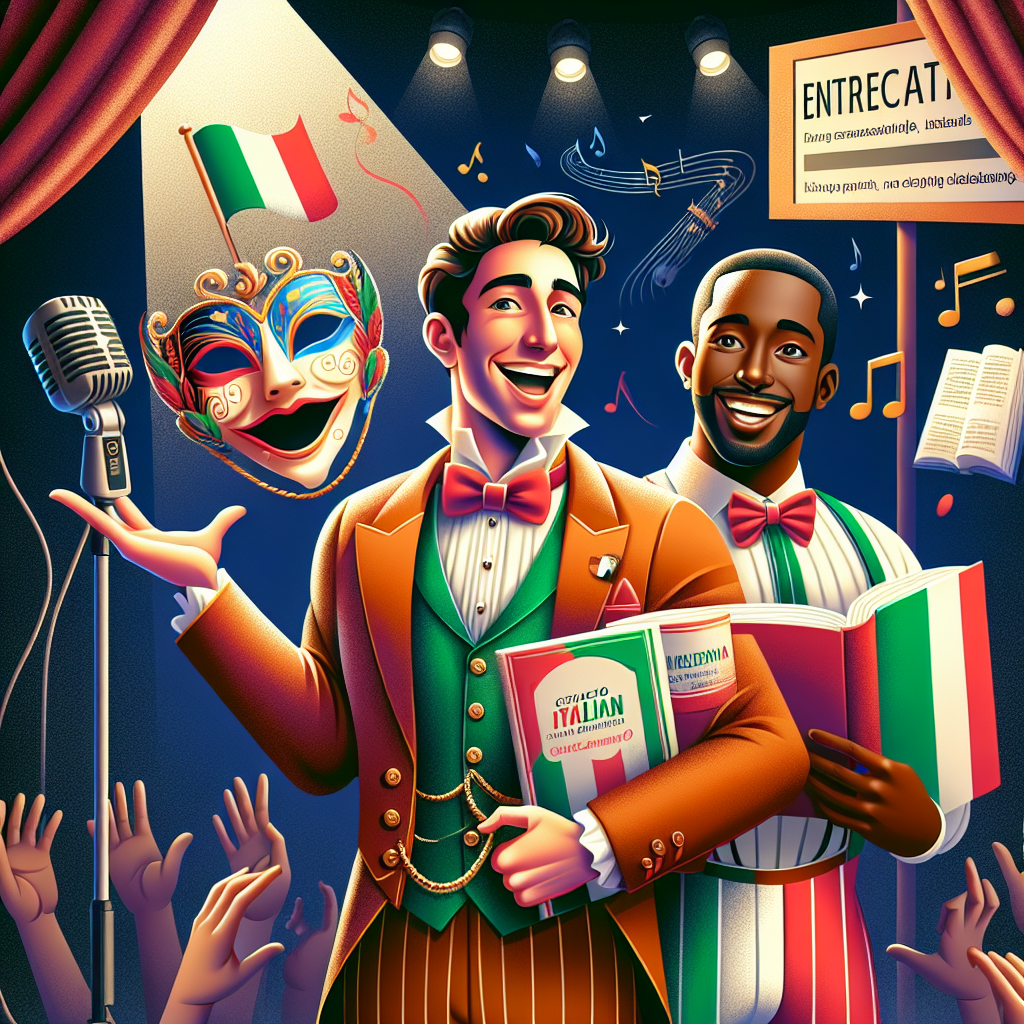
In this engaging first lesson of 'Italian for Beginners,' host Luigi introduces listeners to the Italian language through a charming theatrical performance. Join Conor, a new student, as he ...
Italian for Beginners: Lesson 1 - Una nuova avventura
Education •
0:00 / 0:00
Interactive Transcript
spk_0
Benvenuti amici!
spk_0
Welcome to our language theatre!
spk_0
Come on in, my friends!
spk_0
Take a seat!
spk_0
Make yourself comfortable and get ready for a uniquely enthralling experience.
spk_0
My name is Luigi and I'll be here to walk you through this exciting journey.
spk_0
You may be asking yourself, what sort of journey is he talking about?
spk_0
Well, my friends, you're about to enjoy a charming theatrical performance and while doing
spk_0
so, you will learn to understand and eventually speak Italian.
spk_0
As the play unfolds, you'll get a chance to see first hand how the language works.
spk_0
Plus, you will discover captivating nuances of Italian culture and experience the
spk_0
thrill of a theatrical performance in the language you are learning.
spk_0
Now, let's take a step back and devote a few words to the format of the show.
spk_0
An Italian teacher, Sylvia, is about to meet Conor, her new student.
spk_0
Conor does not speak Italian.
spk_0
He only knows a couple words he learned as a kid from his maternal grandparents who, as
spk_0
we'll see, are both very proud of their Sicilian heritage.
spk_0
Conor is really keen to start learning Italian.
spk_0
Why?
spk_0
Well, he has a special dream he wants to accomplish.
spk_0
The curtain is up now.
spk_0
Act 1 is about to begin.
spk_0
Here, Sylvia and Conor sit in a cozy room sipping coffee.
spk_0
Many colorful books are lined up on a wooden bookcase and, ep of Italy, hands from the wall.
spk_0
Looks like a language school.
spk_0
Well, let's see what happens.
spk_0
Ciao, Conor.
spk_0
I'm glad to meet you.
spk_0
Benvenuto.
spk_0
Welcome to the course.
spk_0
Ciao, Sylvia.
spk_0
Thank you.
spk_0
Piacere.
spk_0
But before I speak to you more about the course, tell me why you want to learn Italian.
spk_0
Well, because I think the Italian language is so beautiful.
spk_0
See, a vero.
spk_0
It's true.
spk_0
Any other reason?
spk_0
I also love the Italian culture very much.
spk_0
Benissimo.
spk_0
Do you know any words in Italian, Conor?
spk_0
Well, I know the words, buongiorno, buon assiera.
spk_0
Ciao.
spk_0
It's a good start.
spk_0
Any other words?
spk_0
Parole?
spk_0
Yes.
spk_0
Let me think.
spk_0
Pasta.
spk_0
Pizza.
spk_0
Bella.
spk_0
And ragazza.
spk_0
Very good.
spk_0
Molto bene.
spk_0
Those are very helpful words.
spk_0
My mother's parents were Italian.
spk_0
You know, I often heard those words.
spk_0
My grandparents' home, you know, when I was a kid.
spk_0
Very interesting.
spk_0
Well, Conor, I promise you that if you study well by the end of our 22 lesson course, you
spk_0
should be able to understand and speak Italian.
spk_0
Seriously?
spk_0
No doubt about it.
spk_0
Well, are you ready to start?
spk_0
All right.
spk_0
Fantastico.
spk_0
Mama mia, I like your enthusiasm.
spk_0
Come in,
spk_0
Let's now explore the verb essere, which corresponds to the English verb to be.
spk_0
Essere, like to be in English, is an irregular verb whose conjugation follows a special pattern.
spk_0
In English, we say, I am, you are, he is, she is, and so on.
spk_0
You stop using the word B once you start conjugating verbs.
spk_0
The same thing happens in Italian with essere, which is also an irregular verb.
spk_0
Let's now conjugate essere in the present tense of the indicative mood.
spk_0
I am you are, you say, he is, you are, you are, you are, you are, you are, you may have
spk_0
noticed, I said you are twice, but gave you two different Italian translations, namely
spk_0
to say and voiciete.
spk_0
See, I did notice that.
spk_0
Well, in Italian there is a polite form for you.
spk_0
We say, lei instead of two informal speech, whereas we use two among friends, people of the
spk_0
same age and two others as children.
spk_0
So should I use two or lei when speaking to you?
spk_0
Two is fine, and thank you for asking, Conor, you are Molto Gentile.
spk_0
Gentile, Molto?
spk_0
Molto Gentile means very kind.
spk_0
You will need to expand your vocabulary, Conor.
spk_0
I will be introducing more words as we go on.
spk_0
This is exciting.
spk_0
I like it.
spk_0
Bene, I'm glad you like my plan.
spk_0
Why don't we start by pairing essere with the words you already know?
spk_0
If you don't know how to say something in Italian, just say it in English.
spk_0
Let me go first.
spk_0
I am a professor of Italian.
spk_0
Ok, let me try.
spk_0
I am Conor.
spk_0
I am American.
spk_0
Ah, Conor.
spk_0
I am American.
spk_0
With an O.
spk_0
Oh, I see.
spk_0
That reminds me of an old song that when Tuvo fa l'americano.
spk_0
So great.
spk_0
A me ricano is the correct word.
spk_0
Now I know it.
spk_0
Try something with Tusei.
spk_0
Tusei a girl.
spk_0
Ragazza.
spk_0
Molto bene.
spk_0
Tusei Molto Gentile.
spk_0
Io sono Molto Gentile.
spk_0
Tusei funny.
spk_0
Tusei simpatica.
spk_0
Grazie Conor.
spk_0
Sei uno studente.
spk_0
What?
spk_0
I'm sorry.
spk_0
You said sei uno studente.
spk_0
I didn't hear you saying tu, but I guess you're referring to me.
spk_0
Am I right?
spk_0
You are right and I'm actually very happy you noticed that.
spk_0
In Italian, personal pronouns are optional.
spk_0
I can say sono silvia, because sono already indicates that I am the subject of the sentence.
spk_0
So remember, only use a personal pronoun such as Io, for example, when you really want to
spk_0
emphasize the subject performing the action.
spk_0
So I can say sono Conor, sono Americano, and sono Gentile.
spk_0
Correct.
spk_0
Now let's try to use lui-é.
spk_0
He is, and lei-é.
spk_0
She is.
spk_0
Lei è bella.
spk_0
Lei è romantic.
spk_0
Lui è happy.
spk_0
Lei è romantica.
spk_0
Lui è felice.
spk_0
Romantica.
spk_0
Felice.
spk_0
It sounds so poetic.
spk_0
Well, dear Conor, molto bene so far.
spk_0
I'm very happy with our first lesson.
spk_0
Let's get an espresso and come back to practice.
spk_0
Noisiamo voi siete, and l'oro sono.
spk_0
Ciao Conor.
spk_0
Ciao, I'm not leaving.
spk_0
I just got here.
spk_0
I know you are not leaving Conor.
spk_0
I'm sure that you did not forget that we have an important lesson today.
spk_0
We need to practice noisiamo voi siete e l'oro sono.
spk_0
Si, then I don't understand.
spk_0
I thought you usually say ciao when you're leaving a place.
spk_0
I see why you are a little confused, Conor.
spk_0
In italiano, ciao is a friendly and informal way to address people,
spk_0
which you can use both when you see someone and want to say hello to them,
spk_0
and as a way of saying goodbye when you leave a place.
spk_0
Really?
spk_0
Do you know anything about the history of the word ciao?
spk_0
No, I don't think I do.
spk_0
Ciao comes from the Venetian word ciao,
spk_0
schiavo in italiano, slave in English.
spk_0
Slave? Really?
spk_0
Well, once upon a time people would employ the expression ciao vostro,
spk_0
which means your slave or I am your slave as a form of greeting.
spk_0
Something like a match or service?
spk_0
That's right.
spk_0
Over time, this greeting lost its submissive connotations,
spk_0
becoming a general expression of goodwill.
spk_0
It eventually was compressed into the word ciao and spread outside Venice,
spk_0
all over Italy and abroad, all over the world.
spk_0
That's fascinating, Silvia.
spk_0
I've been dreaming about Venice for a long time.
spk_0
So if I say noi siamo schiavi, what does it mean?
spk_0
We are slaves?
spk_0
Exactly, but let's see some other words and practice some examples using noi voi loro.
spk_0
noi siamo noi siamo silvia and conno.
spk_0
Mamma mia, I was just about to tell you something new and you read my mind.
spk_0
Well, to stay on the topic of noi siamo silvia e conno,
spk_0
let me tell you how you can convey this same concept in another way.
spk_0
noi ci chiamiamo silvia e conno.
spk_0
This is getting complicated.
spk_0
It is not complicated, don't worry.
spk_0
Chiamarsi can be translated as my name is.
spk_0
Let me conjugate this verb for you.
spk_0
Io mi chiamo, my name is tutti chiami,
spk_0
your name is lui lei si chiamo noi ci chiamiamo,
spk_0
voi vi chiamate loro si chiamano.
spk_0
So I can either say io mi chiamo conno or io sono conno.
spk_0
Exactly, and remember that the Italian language often drops the personal pronoun.
spk_0
So when you want to know somebody's name, you can use chiamarsi.
spk_0
It's simple, for instance, I can ask you come ti chiami,
spk_0
which can be translated in English as what is your name?
spk_0
Now, try to answer my question.
spk_0
Mi chiamo conno come ti chiami mi chiamo silvia come si chiamano mamma e papa.
spk_0
I know that.
spk_0
Si chiamano, Germanna e Sean.
spk_0
Molto bene, very good.
spk_0
Sono molto felice,
spk_0
con il primo gramo al mio primo conno.
spk_0
So amai silvia,
spk_0
I can't wait to learn more.
spk_0
Music
spk_0
Back and ready.
spk_0
Mamma mia, you scared me.
spk_0
I didn't hear you coming in.
spk_0
Silvia, this is funny.
spk_0
I heard my grandfather Giovanni saying mamma mia,
spk_0
millions of times.
spk_0
I bet you did.
spk_0
It is an extremely common Italian expression, both in Italy and around the world.
spk_0
He would say to my grandmother mamma mia, carmella, la pasta,
spk_0
and then he would do something with his hand, like blowing a kiss with his fingers,
spk_0
ma.
spk_0
He surely loved my grandmother's pasta, which was really good, I have to tell you.
spk_0
How many stories like this do you have?
spk_0
Well, I could write a book about these two.
spk_0
Real soulmates.
spk_0
I can't wait for you to tell me all about them in Italian.
spk_0
Mamma mia, I wish.
spk_0
You'll see, as you learn some of the most common Italian expressions,
spk_0
not only will you make fast progress,
spk_0
but you will also sound like a real Italian.
spk_0
Io sono italiano.
spk_0
That is what I would like to say without an accent.
spk_0
You know, having an accent is not a problem and can even be multi-romantic.
spk_0
Mamma mia, a ragazza in Italia, my vespa.
spk_0
It sounds like music to my ears.
spk_0
Music?
spk_0
It's so great to hear you say that, Cornor.
spk_0
By the way, speaking of music, Silvia,
spk_0
do you know that song by Abba called Mamma mia?
spk_0
Mamma mia, it was a hit back then and still is.
spk_0
Actually, this is the perfect example of a commonly used expression
spk_0
spread into other cultures.
spk_0
And so widely did this one spread all over the world
spk_0
that it became the chorus for one of the most popular songs of all time.
spk_0
That's true, but does Mamma mia have anything to do with the word mother?
spk_0
What does it mean, really?
spk_0
Well, literally the expression means my mother,
spk_0
but we never use it like that.
spk_0
In fact, to say my mother, we say mia mamma,
spk_0
switching the two words.
spk_0
I got it.
spk_0
Mamma mia is very often used to express a surprise.
spk_0
For instance, I said that when you walked into the room earlier
spk_0
and I wasn't expecting you.
spk_0
It can be translated in English as,
spk_0
oh my, or my goodness.
spk_0
Mamma mia, now I understand very well what you're talking about.
spk_0
Cornor, say uno student molto bravo.
spk_0
You are a very good student.
spk_0
You are a very good professor.
spk_0
Time to say goodbye, Cornor.
spk_0
Arrivederci.
spk_0
Ciao Silvia, grazie.
spk_0
That's it, my friends.
spk_0
I'm Ichimie.
spk_0
We've come to the end of the first installment of our show.
spk_0
I hope you are as enthusiastic about learning Italian as our new friend Cornor.
spk_0
Now take my advice and study the lesson available on our website.
spk_0
Then, listen to the grammar and expression dialogues.
spk_0
Oh, I almost forgot.
spk_0
Make some time to perform our grammar and pronunciation exercises.
spk_0
Well, the curtain is down.
spk_0
The intermission begins.
spk_0
I will see you soon in at 2.
spk_0
Bye for now.
spk_0
Arrivederci.
Topics Covered
learn Italian
Italian culture
language theatre
Italian expressions
teaching Italian
Italian vocabulary
conjugation of verbs
Italian phrases
language school
cultural nuances
theatrical performance
Italian language course
personal pronouns in Italian
common Italian words
Italian greetings
Italian heritage